giovedì 28 novembre 2013

The 4 Language Skills and "The Doctor"

Have you ever watched the popular British sci-fi TV series Doctor Who? Well, last 23rd November was celebrated its fiftieth anniversary with a special episode "The Day of the Doctor",
which was shown on BBC ONE and simultaneously in 94 countries worldwide. I'm not a Whovian, but this show achieved the Guinness World Record for the largest ever simulcast of a TV drama. So I thought why don't we have a lesson about this famous time traveler? Why don't we use all the four language skills together?
Do you want to have some fun with your teenage students? Here you are my lesson plan!


Students: PRE-TEENS/ TEENS
Level: A2/B1
Time: 60 MINUTES

1. Stick this picture with a magnet on the whiteboard and write A MYSTERIOUS BRITISH TV CHARACTER. (5 mins)
2. Now give your students some hints. (You can decide to show them one by one or all together).


3) My students guessed it immediately. If your students have troubles to understand who the mysterious character is let them use the internet. When they have the right name, show them this picture.


4) Now students can start a short brainstorming session about Doctor Who (3-5mins). (This was my whiteboard afer about 30 seconds). This short activity is helpful to elicit useful vocabulary for the next session.

5) JIGSAW READING --> SPEAKING (15 mins)
Students have to read two different texts in pairs:
After reading their short paragraph they have to answer 3 questions which are about the text their partner have. 
(Get  feedback to be sure everyone has the correct answers.)

6) LISTENING (10 mins)
6a) SILENT WATCHING 
Tell your students you are going to watching the trailer of "The Day Of The Doctor". First time they watch the video, the volume will be off. Ask your students to name as many things as possible.
6b) LISTENING FOR DETAILS
Students will watch the video 2-3 times  to answer the following questions:
1. How long has The Doctor been travelling?
2. What did he fight for?
3. What does our future depend on?

7) WRITING (20 mins)
Show your student this comic strip and tell them to write a dialogue using speech bubbles in pairs.
 (My students used post-it notes.) Do you want to have more fun? Hold a competition. Tell them the best story will win a prize. Get some candies ready ;-)

giovedì 21 novembre 2013

Homework Is... Fun!

My classes in small groups usually take place once or twice a week. I know it's difficult to keep your English fit out of the classroom if you don't live in an English speaking country. For this reason, homework is a great solution to help students use the language during the rest of the week. However, boring homework produces the opposite effect: students don't do it. Here you are some tips to give your students  interesting homework


1. Creativity
- Create a Role-Play using the Target Language learnt in class.
Example: If you have taught useful expressions at the airport, ask students to create a role play about booking a flight.
- Change the ending of a story read in class.
Example: If you have had a reading activity, ask students to re-write the end of the story.
- Write a paragraph, an article, an email or an essay about a topic explored in class.
A writing exercise can be used at any level. From the beginner (a paragraph about the family) to the advanced level (an essay about the advantages and disadvantages of mobile phones).

2. Interaction
- Interview a member of the family or a friend.
Example: Two weeks ago my upper-intermediate students interviewed an important person in their life in order to use present perfect simple/continuous, past perfect simple/continuous, past simple/continuous.


- Do a survey.
Example: If you have taught food vocabulary, ask students to carry out a survey about their families' food habits.
- Find someone who speaks English offline or online and do some practice.
Speaking to a mothertongue people is one of the best exercises a language learner can do. You can suggest some websites where students can find penfriends such as www.conversationexachange.com 

3. IT
- English Attack 
Every week you can find a free video booster which is an activity based on the vocabulary of a movie.
- Learner's Dictionary
In monolingual classes students usually try to translate the new vocabulary learnt. Ask them to have a note book where they can jot down the meaning of the new words (in English, of course).
- Johnny Grammar
Everyone has a smartphone. Ask students to download an app they can use when they have spare time to improve their grammar knowledge.
- Youtube
Do what you like and you will learn. Ask students to listen to their favourite songs using videos with lyrics.


4. AVOID Gap-filling exercises
I don't know why but everytime I gave this kind of exercise students came up with an excuse because they hadn't done it. Perhaps it's just my personal experience, but I think students find these exercises quite boring.


5. AVOID Group work
Both young learners and adults are pretty busy (school or work) and this means that only some of the members of  a group will do the activity at home.


What homework has turned out to be more efficient with your students? Share your experience with me!

giovedì 14 novembre 2013

When Tradition Becomes Innovation

I don't like labels but if I have to include myself in a millenial generation I have to say I belong to Generation Y. Most of my students, on the other hand, belong to Generation Z.
I'm one of those people who could live with a mobile phone that just lets me make calls and send text messages. Using the computer only at home or at school wouldn't drive me crazy and I could survive without an I-pad. Could Generation Z say the same? Maybe not! 
So we teachers try to keep our methods up-to-date in order to make our lessons fun and engaging.

Last weekend I was tidying up my parents' attic and I came across my old computer, which looked like this one in the picture. I started to remember happy memories from my youth and I thought about the games I used to play when I was a teen and how they could be effective  for teaching English to teenagers.

I used these games to review grammar and vocabulary this week.


GAME 1
MUSICAL CHAIRS
This is a classic game for parties. Chairs are set in a circle with one fewer chair than there are players. As the music plays, the players move around the chairs. To make the game more suitable for the dance party theme, have the players dance as they move around the chairs. When the music stops, the players scramble to sit down on one of the chairs. The person without a chair is out of the game. Remove one of the chairs and repeat the process until only one person is left. I changed a little the game by asking a question to the student without the chair. If they answer correctly they go on playing otherwise they are out of the game. Remove one of the chairs and repeat the process until only one student is left. I used this game to check if my pre-teen students remembered COLLOCATIONS with MAKE and DO. You can use it to review vocabulary or grammar.

GAME 3 
THE GAME OF THE GOOSE
This is one of my favourite game (I used to play it when I was younger than a teen). You just need a dice, 1 counter per player  and a gameboard you create according to your studentes' needs. I created this one for my teen students who had to review the past simple. They really enjoyed it because they had the chance to review History topics, too! 


GAME 3
BATTLESHIP
My father who works on tanker ships taught me this game. This is a game for two players where you try to guess the location of five ships your opponent has hidden on a grid. Players take turns calling out a row and column, attempting to name a square containing enemy ship.  There are one length 2 ships, two length 3 ships, one length 4 ship, and one length 5 ship. Instead of ships I used words. After my second group of teens had studied vocabulary about the house I divided them in two teams (two players) and they put on the grids words which were 4, 5, 6, and 7 letter long. 


Have you ever dug up anything from your past to make your teaching method(s) more effecttive?
I'd like you to share your experiences with me!


giovedì 7 novembre 2013

What The British Do Not Say... A Lesson Plan

Has any of your intermediate student ever asked you the following question?
"How can I sound more English?"
If yes, what is your answer?
Personally, a language is not just grammar and pronunciation. A language is communication, people, culture, traditions, customs. You cannot speak a language if you do not know its people. Thus, I introduced a new students' activity in my course: CULTURAL SHOCK. Why a shock and not simply "a cultural communication meeting"? Because everytime my students are told something about the British culture they look at me with a puzzled expression and say: "Reallyyyyy?"

A couple of months ago I read this article http://www.telegraph.co.uk/news/newstopics/howaboutthat/10280244/Translation-table-explaining-the-truth-behind-British-politeness-becomes-internet-hit.html and I thought that this chart was brilliant to teach my students what to understand (and reply) when they deal with British people in daily situations:


LESSON PLAN
LEVEL: INTERMEDIATE ADULT STUDENTS
TIME: ABOUT 1 HOUR
1.  Ask your students to come up with stereotypes about British people.
(weather, tea, the Queen, politeness, etc.) (5 minutes)

2. Introduce the topic of BEING POLITE by showing your students this picture and ask them: "What's happening"'? (5 minutes)

3. Give each student a copy of the above picture and ask them to write what the drawning man said in the two situations. (5 minutes)

4. Once the students have filled in their speech bubbles make them compare with each other. Then show them the original picture. Feedback. (5 minutes)


5. Students read this passage from the book New English File Intermediate and answer the following questions:
a. Why did Miranda get angry the first time she met Alexander?
b. Why was Alexander surprised?
c. What is their agreement now?
(10 minutes)


6. Once you have cut out all the expressions from the chart stick them on different colour cards. 


- Divide the students in two groups. 
- Students of group one will have WHAT THE BRITISH SAY cards and students of group two will have WHAT FOREIGNERS UNDERSTAND cards. (Give each student a card, you can do more rounds or select only some expressions). 
- Students stand up and go around the classroom to find their partner.
- Monitor well, when the students find their partner they can sit down next to each other. (10-15 minutes)

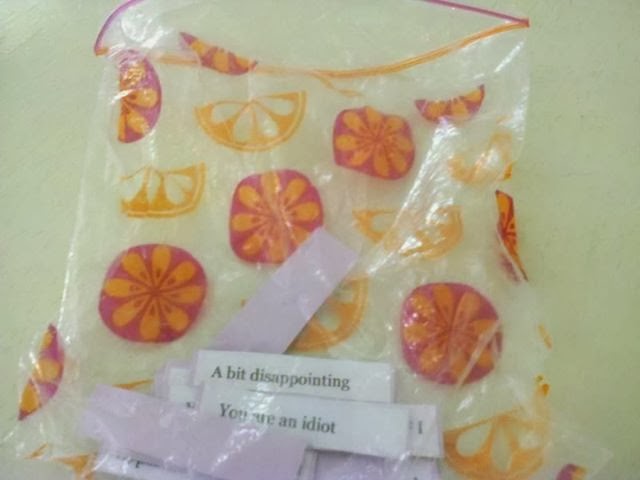
7. Once all the students are sitting next to their partner. Show your students a plastic bag with the WHAT THE BRITISH MEAN cards in.


- Students in turn pick up a card and read it aloud. The pair who have the corresponding WHAT THE BRITISH SAY and WHAT FOREIGNERS UNDERSTAND must raise their hands. (10-15 minutes)

My students and I had a lot of fun! I hope you will enjoy it, too!


giovedì 31 ottobre 2013

Kick Off Or Sum Up? Find A Treasure!

As a teacher I would like my students to achieve their goals when they learn English. However, the learning process is long and complex so I've been looking for new strategies to make it pleasant, engaging and above all effective.
Learning is a treasure. So why don't we review or introduce a new topic with a treasure hunt?


A treasure hunt is an excellent way to make your students:
- work together,
- teach each other,
- feel motivated,
- practice listening and speaking skills.


Here you are two examples of my personal experience:

Case 1
I used a Treasure Hunt at the end of a course in order to review the grammar and the vocabulary we studied. The hint cards were divided in two parts. As you can see, at the top there are questions and at the bottom there are hints to find the next question.

The treasure my students found was a British flag neckerchief.

Case 2
Last October 4th I started a new course with 6 adult intermediate students. In order to introduce three different general topics
1. Pronunciation (minimal pairs, tongue twisters, homophones)
2. Spelling
3. British English vs American English
we were going to deal with during the course I used this treasure hunt*.This time there was not any material treasure but a special sentence students had to find out by taking a letter from each hint. I was impressed because working in pairs allowed all of them to succeed in finding the treasure.
What is the sentence? Why don't you try to find the treasure? Write a comment with the sentence and I'll let you know if you are right!

*Tips for teachers: (The activity lasts 60-65 minutes/ every round takes 4 minutes)
1. Cut out the cards.
2. In pairs Ss get a card and they have 4 minutes to write the hint on a paper.
3. T monitors and interacts with Ss when there are LISTENING cards.
4. At the end of the 4 minutes T tells the pairs if they can get another card or keep sorting out the previous one.
5. When Ss have all the hints, they try to find out the treasured sentence in 4 minutes.

giovedì 24 ottobre 2013

To Listen Or Not To Listen To Real English, This is The Problem

If you teach English in any English speaking country your students are more likely to hear native people talking. If you teach English in any other place (such as in Italy) what happens when your students run into the real English language? 
Most of my students - especially adults - think listening is a pain in the neck. They are able to do exercises with tapes from course books but when it comes to listening to mother tongue people talking at their normal speed they get clearly puzzled. 
In my classes I always prefer using real materials rather than course books, but I have always been torn between graded tapes and normal-speed recordings when I have to teach listening skills. So if a real recording is difficult why don't we grade the activities? Here there are a few ideas I used with my students last week.
A movie trailer
For the International Chocolate Week I decided to teach listening skills to my pre-teen students by using the trailer of Charlie and the Chocolate Factory.

1. Students watched video with the audio off to get an idea about the topic.

2. Students were taught some useful vocabulary.

3. Students watched the video and answered multiple choice questions. 

They all got their answers right.


A speech
My teen students have been studying the reported speech. In their last lesson they played the role of journalists who had to report about one of Steve Jobs' speeches. 
1.They watched the video with subtitles.
2. They repeated some of his statements (improving their pronunciation as well).
3. Every one reported a statement while they others had to agree if the reported form was correct.
4. Students were filmed while reporting the news.

A real conversation with mother tongue people
I recorded mother tongue people asking and answering random questions.
1. Students were given the context and situation for each question.
2. Students listened to the questions (only).
3. Students wrote the possible answer on a piece of paper.
4. Students compared their answers.
5. Finally they listened to the answers.


I hope these ideas will be useful for your lessons!

Have a lovely day

giovedì 17 ottobre 2013

The Power Of Post-it Notes

Here we go with a new post! Yesterday I had three mini group classes: PRE-TEENS, TEENS and ADULTS (intermediate). At the end of the day while I was tidying up I realized I had used post-it notes in every lesson. I think post-it notes are practical, handy and we can use them in several situations. Here you are three different ways to use post-it notes.

1. PRE-TEENS 
Present Simple: Question Form
Many students think the question form is as clear as mud. Some students forget to use the auxiliary do,others use do instead of does.
I took some post-it notes and wrote down a word (or two) on each of them. All together they make a question. Then I messed them up and I stick them up on the board. The students had to rearrange the words  in order to make a question. Everytime the students made a mistake I put an alarming sound so they knew they were wrong and they changed the position of the post-it notes. These are just two questions they made. The colour of the post-it notes helped them create the right question.

2. TEENS
My teen students started reading a graded reader book yesterday. It is about a teenager who plays video games. They brainstormed vocabulary about videogames and then I gave them two sets of post-it notes. On the light blue notes there were words and on the orange notes their definitions. In pairs the students had to match them in three minutes. 


3. ADULTS
Adult students love studying functional language (requests, complains, invitations) because they use it in their daily life. After listening to short dialogues and noticing the new language about giving suggestions the students were divided in pairs and were asked to look around the classroom so they could notice post-it notes on the walls. There were three types of post-it notes: 1) Suggestions 2) Replying positively 3) Replying negatively. Each pair was given a type to find out and stick up on the board. The board looked like this midway through the activity.

When and why do you use post-it notes? Please share your answers with me.
I hope this post was useful and you might use these activities in your lessons.

Have a lovely day

Larissa