Visualizzazione post con etichetta games. Mostra tutti i post

martedì 18 febbraio 2020

'Station Squabble': a picture-telling activity

Hi folks,

here I am again with a new teaching idea I came up with thanks to a photograph which went viral last week. I'm talking about the shot 'Station Squabble' which has made Sam Rowley win the Wildlife Photographer of the Year LUMIX People's Choice award. Apparently Sam spent late nights at a central London tube stop, down on his belly trying to get the perfect low-angle view. His two subjects had been foraging separately until they chanced across the same morsel of food. For a split second, they argued over who should have it before then going their separate ways.
If you haven't seen the picture yet, I am sure your curiosity has been aroused. I'm not going to show you the photo now, though, I'd like to share my lesson plan first!


Level: A2
Age: Pre-teens/Teens
Target language: Cohesive devices - Substitution/Ellipsis + Sentence stress

Procedure:
1. Warm-up activity - Call My Bluff
Board the phrase 'Station Squabble', most Ls at this level will struggle to understand the meaning of 'squabble' so you can play the game Call My Bluff.
Provide Ls with three/four definitions of the word squabble, but only one of them must be correct ('an argument over something that is not important' - www.dictionary.cambridge.com).
Ls in pairs/small groups guess which the correct definition is through a poll activity. (If you're a tech-savvy teacher, you might use this website.)

2. Self-assessment
Without telling Ls which definition is the correct one, ask them to read a short dialogue which is an example of a 'squabble' that really happened between two friends. This task will get Ls to understand whether their answers were right or wrong and avoid direct teacher's corrective feedback.
3. Working on the text
Ask Ls to work in pairs.
a. Ls decide which word is missing in the first line. 
b. Ls describe the two characters (whose name is the same).

4.a Focus on TL
Ask Ls work in small groups.
a. Ls try to explain the difference between 'my' and 'mine'.
b. Ls say which word 'did' replaces.

Substitution involves some linguistic item substituting for another item occurring in the prior linguistic context.

Ellipsis is like Substitution except that it involves deleting information recoverable from some prior context rather than replacing the information with a word like do or so. (Meyer, 2002)

4.b Focus on Phonology - Sentence stress
We know that grammar words are usually unstressed. However, in this short dialogue they are. Drill the sentences focusing on the stress by using bullets on the words which are 'strong'. 


5. Showing the photograph
It's time to show the photograph! 
Tell Ls you have a picture of the squabble you've been talking about. Show it to your students and they check out their predictions.
Sam Rowley/Wildlife Photographer of the Year

The word missing is 'food'; the phrase 'food morsel' is correct, too. 


mercoledì 4 settembre 2019

'Escape EFL Classroom' workshop: Behind the scenes - Game-based learning and gamification (1)

A new school year is about to start here in Italy and I am ready with a new project. If you have been following this blog, you would know by now that I am really into games. Thus, my new workshop for secondary school students is a special Escape Room, which is a 60-minute real-life adventure game. When I played this game for the first time with a group of friends I immediately thought it was great for my students because
-  it involves the use of the four linguistic skills,
-  it promotes peer-learning, 
-  it entails different teaching methods and approaches which suit different types of students.
I have decided to write a series of blogposts about my new workshop which analyse the different parts of it. Today I will start with the reasons why I use games in my workshops for students and teachers. 


Why 'gamification'?

Kapp describes gamification as ‘the careful and considered application of game thinking to solving problems and encouraging learning using all the elements of games that are appropriate’ (Kapp, 2012, p.12). We can infer, thus, 'gamification' is an integration of game elements and game thinking in activities that are not games. In particular, games have some distinctive features which play a key role in gamification:
- users (students) are all participants,
- challenges/tasks that users perform and progress towards defined objectives ('levelling up' raises interesting questions for educators - not least the fact that players are allowed to tackle challenges and tests like exams as many times as necessary - and with no lasting consequences - in order to progress from one level to another),
- points that are accumulated as a result of executing tasks,
- levels which users pass depending on the point.

Why 'game-based' learning?
Unlike 'gamification', which adds game-inspired elements to your teaching practice (e.g. points), 'game-based' learning entails the use of games to meet learning outcomes. It is through the game that students learn. Moreover, playing games is intrinsically motivating because by and large it’s a voluntary activity. Games encourage independent inquiry and exploration; interests and passions can branch off from the individual game. Finally, a consensual and transparent adherence to a fictional setting or role allows players to experiment with skills and identities without suffering the consequences of failure in real life.

In my next post I'll be writing about what traditional Escape Rooms are. Stay tuned!

For further information about the 'Escape EFL Classroom'
workshop email me spiceupyourenglishclass@gmail.com.

Bye for now,
Larissa

lunedì 26 agosto 2019

Generation Z and Social Networking Apps: Back to School and Instagram

Some time ago I started my DipTesol independent research about the use of social networking apps to engage learners in communicative tasks inside and outside the EFL classroom. Last spring I also set up a closed Facebook group to share activities which include the use of social networks to learn English as a foreign language. 

Social scientists who study young people have found that their digital use can be inventive and even beneficial. This is true not just in terms of their social lives, but their education too. In fact, thanks to the online world, young people can now publish ideas not just to their friends, but to the world. And by writing for strangers, their sense of “authentic audience” makes them work harder, push themselves further, and create powerful new communicative forms.

One of the apps which is most used by young people in Italy and in Europe is Instagram, which is a social networking service built around sharing photos and videos. (If you want to know more about it, check this article.

It is almost time to start your lessons again and I know you are more than excited to meet your new and old students! I am also sure that you are looking for an activity which is not the usual 'What did you do last summer?', though. This the reason why I am going to share with you the following Bingo game.


RULES OF THE GAME

1. Distribute the cards and pens or pencils to each student.
2. Tell the players that they must interview each other. Have each player go around the group and ask other students questions.
3. When they find someone who replies positively to their question, they have to write down their name and then move on to another student for another question.
4. The student who first completes the grid with 9 different names, raises his/her hand and shouts, “Bingo!”
E.g. A: Did you use #summer and #beach?
B: Yes, I did.
A: Can you show me, please?
B: (Showing his/her Instagram account) Here you are.
A: (Writing down B's name) Thank you.

Download the template here. You will also find a blank template you can use to write down your own questions.

Have a wonderful back-to-school time!

Bye for now,
Larissa

Ps: If you use this activity, let me know your feedback please!
If you are interested in learning how to use social networking apps in your English classes, email me spiceupyourenglishclass@gmail.com.

lunedì 10 dicembre 2018

POINT YOUR FINGER: a game my adult learners really enjoy


A few weeks ago I gave one of my workshops for teachers about how to use games in order to teach English as a foreign language. Only one of the participants didn’t show interest at all, and yes I took it at heart. I approached the neglectful lady while everyone in her group was focused on the task and she was phubbing instead. ‘I don’t want to sound rude but’, I began. She looked up, glanced at me then looked down back to her smartphone. I hesitated but then I continued, ‘Don’t you like this game? In the next session there will be more exciting activities, don’t wor…’, ‘I don’t care at all, my boss paid for this course but I teach adults, professionals, business people, I have nothing to do with snotty kids’, she cut me off. Well, at that very moment the angel me and devil me started arguing. ‘Move on to the next group and try to be helpful’, ‘No way, she insulted all your theories you should show off your knowledge about how powerful games are for adults when it comes to learning’. As you know (or you don’t), I chose to follow my angel me’s advice and I carried on with my monitoring activity’. 
That evening, on my way back home, I couldn’t help but wonder, ‘ Why do so many people still think that games are only for kids? And more importantly, what’s wrong with adults playing games?’ 
I’m sure that adult students’d better let their hair down after a long day at work rather than being in the spotlight if they got an irregular past simple wrong. Especially professionals and business people who are always under pressure benefit more when they learn in a playful environment.  
There is no doubt that children’s learning process is way too different from the one of adults but a playful activity has never harmed anyone. There are games for children and games for adults, there are games for children which can be adapted for adults. There are games adults like and games they do not like but that doesn’t depend on the fact that playful activities are only for kids but because the structure or goal of the game isn’t interesting/exciting enough. 
This is the reason why I’d like to share with you one of the games my adult students enjoyed most. 

GAME: Point your finger


LEVEL: Intermediate - upwards

LINGUISTIC SKILLS: Speaking/Listening

GRAMMAR FOCUS: Have you ever + Past participle? 
                                   Present perfect VS Past simple

NUMBER OF PLAYERS: 4-6 p/group

WHAT YOU NEED: 1. A set of ‘Have you ever…?’ cards

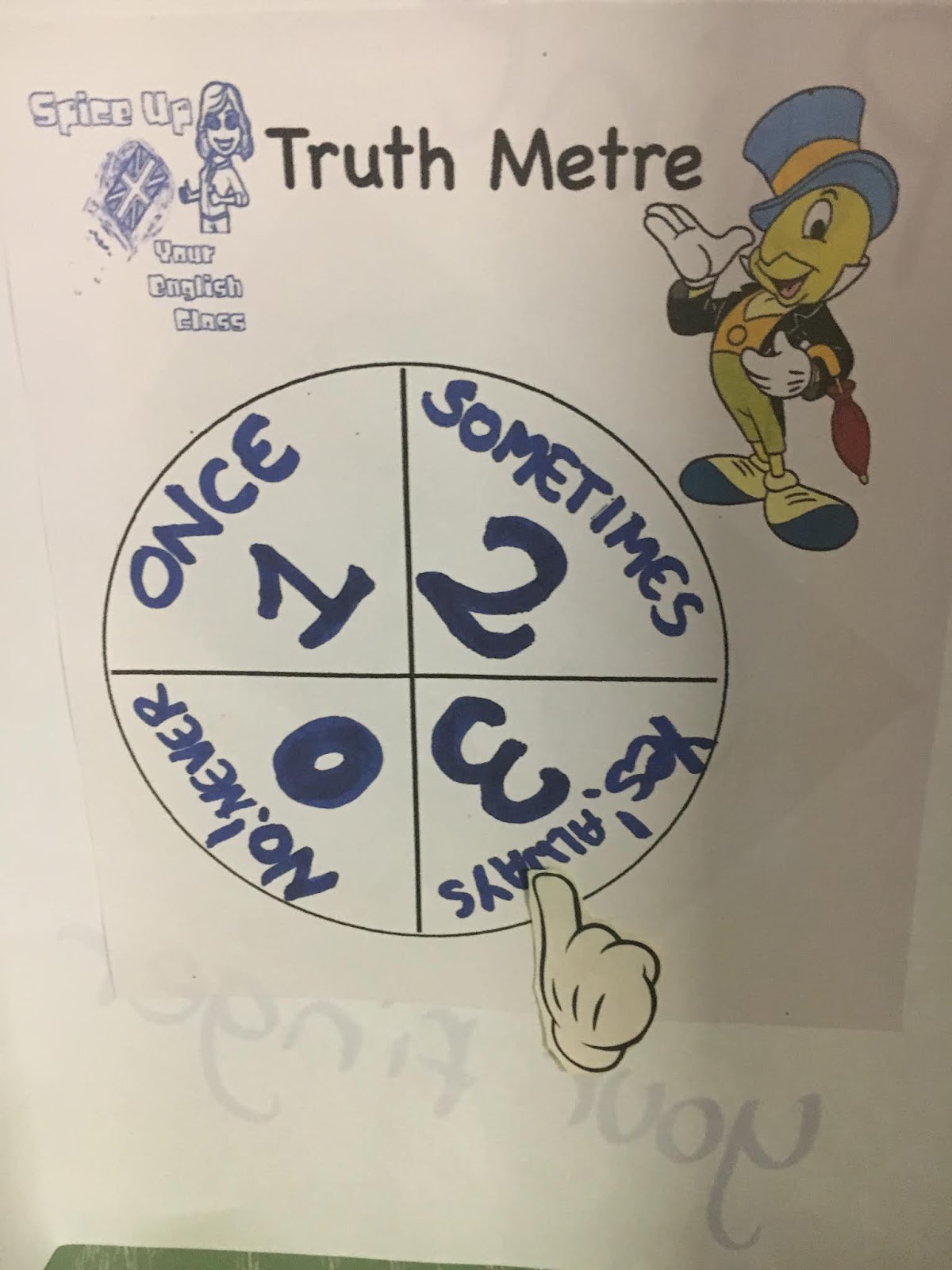
2. A truth metre and sticker finger for each student. (Tips: 1. Fold an A4 paper in 3 parts so that the truth metre cannot be seen by the other students. 2. Use a sticky note to make the finger.)
RULES: 1. Ask one of the students to pick a ‘Have you ever…?’ card and read out the question. 
2. Everybody (including the student who has read out the question) needs to stick the finger onto one of the four options:
0=never
1=once
2=sometimes
3=always
(Students need to be careful not to show their answer.)


'Truthmetre'
3. When everybody has answered (I suggest that you set a time limit), ask students to point their own finger at the person they think has answered 3 (always). 
4. Start to check the answers by asking the student pointed by the one who read the question and then continue clockwise.
5. The students who have pointed to the ones who have answered 3 win 3 points, those who have pointed to the students who have answered 2 win 2 points and so on.

When I played this game for the first time I was amazed because when a student said, ‘0’, she couldn’t stop talking, she had to explain about her answer because the students who had pointed at her wanted to know why she answered ‘never’. Honestly, all the students talked a lot because they were eager to share their personal experience, I had to stop them talking! 

It was such a pleasure to see them speaking English and having fun. 
Thus, ‘fingerly'-speaking, thumbs up for games, all the time… all ages!

sabato 6 ottobre 2018

Jenga in the EFL classroom

Hi everyone!

Here I am with another board game you can play in your EFL classroom!

Name: JENGA
Rules: http://www.jenga.com/about.php

In my opinion this game is great because it can be adapted to different levels and needs.
I used the following activities with my learners.

ACTIVITY 1
Level --> Beginner to Advanced
Age --> Teenagers/Adults
Type of activity --> Ice breaker
Skills practised --> Speaking and Listening

Before the lesson: 1. Put ice-breaking questions on the Jenga blocks.
2. You can either use labels or permanent markers.

During the lesson: 1. Each learner pulls a block.
2. They need to answer the question AND ask it to someone else.


ACTIVITY 2
Level --> Beginner to Advanced
Age --> Any
Type of activity --> Storytelling
Skills practised --> Vocabulary, Speaking, and Writing

Before the lesson: 1. Put words on the Jenga blocks.
2. You can either use labels or permanent markers.

During the lesson: 1. A learner pulls a block and starts a story using the word on that block.
2. The next student uses the word they pull to continue the story.
3. If the tower falls they need to quickly end the story.

In case you have a large class: While each learner comes to the front and continues the story, have the whole class write their own version using the blocks pulled.


ACTIVITY 3
Level --> Beginner to Advanced
Age --> Any
Type of activity --> Revision

Before the lesson: 1. Put numbers on the Jenga blocks.
2. You can either use labels or permanent markers.

During the lesson: 1. Divide the class in two teams.
2. Have two learners from each team come to the front of the class.
3. Ask one of the two students to pull a block.
4. Read out the corresponding question.
5. The first student to answer the question correctly can choose if they want to pull a block, or have the other team pull a block.
6. Once the next block is pulled, read out the question corresponding to that block.
7. The first team to make the tower fall loses.


ACTIVITY 4
Level --> Intermediate +
Age --> Teenagers/Adults
Type of activity --> Recognising minimal pairs
Skills practised --> Listening (Receptive pronunciation)

Before the lesson: 1. Put two different colours on the Jenga blocks.
2. Choose some minimal pairs to focus on, e.g. /iː/ /ɪ/

During the lesson:
1. Tell the class that each colour corresponds to a sound.
2. Read out a word.
3. A learner needs to pull the right block.
4. If the learner pulls out the wrong block, let them play again.


I'm sure you will have more ideas and I'd be pleased if you could share them.

martedì 14 agosto 2018

Hit The Target - A brain teaser for your summer holidays!

‘Tis the season to close books and put them away. Teachers and students alike are ready to set off on their summer holidays but wait, what about English?
Here you are a game you and your students can play under a beach umbrella!

Name of the game: Hit The Target 🎯
Level: B2 upwards
Age: teenagers, young adults, adults
The game can be played individually or in pairs.


Objective
Starting from the word indicated by the arrow, reach the center of the target by eliminating all the words included in it, which can be found in any ring, not necessarily in order, according to the rules below.

Rules

1) The word can be an anagram of the previous one.


2) It can be a synonym or an antonym of the previous one.


3) It can be a homophone (a word that is pronounced like another word but has a different spelling or meaning, for example some, sum /sʌm/) of the previous one.

4) It can be obtained by adding, removing, or replacing a letter in the previous one.


5)It can be associated to the previous one because of an idiom, collocation or saying.


6) It can form, together with the previous one, the name of a celebrity, or a place.


7) It can be associated to a work of art (book, theater, poetry, etc.), its author, or its title including any genre.


In your answer, you should explain and/or justify each association.

I made the one below for you, have fun and enjoy your summer holidays!


E.g. The first word is WILLIAM, the second word is PRINCE (Prince William), word number 3 is KISS because it's the title of one of Prince's songs.
Last but not the least, here you are template to create your own HIT THE TARGET! 


P.s. If you want to know all the answers, leave a comment! ;)

martedì 23 gennaio 2018

Animal 🐠🐶🐴idioms out of the box 📦

GAME:Animal 🐴🐶🐷🐱🐠🐝idioms out of the box 📦

Target language: idioms which include animals
Level: B2-C1
What you need: a shoebox 
Pictures of animals
Words (which form the idiom) on paper strips

Rules of the game
1) Learners in teams (pairs/small groups) try to create idioms which include animals using the pictures and the words from the shoebox.

2) When they think they have one ready they shout out "miaow miaow". 

3) Teacher checks it out and if it is correct they win one point. If it is not they need to put the picture+words back into the box and try a new combination.

 4) When all the idioms have been created, the teacher will give the whole class feedback by writing the idioms on the board eliciting their meaning.

5) Learners change teams. One team calls out an idiom and the other teams have to come up with a sentence which includes that idiom. The fastest team wins a point and must call out the next idiom.

My students and I had a lot of fun and I hope this post might be useful with your students, too! 

domenica 26 novembre 2017

Teaching For Exams? Have fun! Word Formation... Bingo!

⚠️UPDATE⚠️
This blog post has been shortlisted for this month’s TeachingEnglish blog award 💖🥇

Hi  again my fellow EFL teachers!
Are you in trouble with training your students for English language exams? Don't worry! Here I am with a new, fun game you can play with your students!

This time I'm focusing on:

Cambridge First Certificate
Reading and Use of English part 3
This task is called word formation and it focuses on candidates' knowledge of how prefixes, suffixes, internal changes and compounds are used in forming words.

So many affixes, which don't always follow a rule, drive my students nuts. Thus, I created this simple, but fun game!

What you need:
a 3x3 grid [students can make their own grids during the lesson]
pencils/pens
What you have to do:

If you make copies beforehand, write a suffix (e.g. -ist) or prefix (e.g. ir-) on the top of each box and write a grammar category (e.g. person noun), whether the word is negative/plural at the bottom of each box. Otherwise, you can write the affixes and the other information about the word formation on the board and ask students to copy them on their papers.

Rules of the game:
1) Once all the students have their grids,
E.g.


the teacher says a word
E.g. football
2) The teacher says a grammar category
E.g. noun person
3) The learner writes the noun person for football in the right box. --> Footballer 

4) When the learner has completed all the boxes, s/he shouts out BINGO!

The list of words for the grid above are:
- football (person noun)
- society (adjective)
- survey (person noun)
- polite (abstract noun)
- maintain (abstract noun)
- relevant (negative adjective)
- journal (person noun/plural)
- patience (negative adjective)
- happy (manner adverb)

5) To make it more challenging add a few more words to the list which don't fit in the grid. Students need to realise that they must not write anything when the teacher calls out that word + grammar category. Remember to tell them before you start playing!
E.g.
- kindness (negative adjective --> UNKIND)
- politics (person noun --> POLITICIAN)

IF YOU'RE LOOKING FOR MORE GAMES TO PRACTISE THIS PART OF THE EXAM, TAKE A LOOK HERE.

mercoledì 18 ottobre 2017

Egg-straordinary phrasal verbs

Hi everyone!

Here I am to introduce a new game I've been playing with my intermediate and upper-intermediate teen learners.

The focus is on phrasal verbs. What are phrasal verbs? Take a look at this blogpost! Phrasal Verbs at a glance


Activity: Egg-straordinary phrasal verbs

Aim: Practise phrasal verbs in context

Age group: Teenagers and adults

Materials: an egg carton, disk-shaped tokens, timer, paint, paper, pens (pencils)
*Students work in groups of 3-4 so you may need more egg cartons and copies of the disk-shaped tokens.

Before the class:

1) Paint four random sections of an egg carton any colour.
2) Print and cut out the tokens. There are two types of tokens, the blue ones are the particles (prepositions and adverbs) and the purple ones are the verbs.

During the class:
1) Put all the tokens in the top of the egg carton, close the lid, shake the carton, and flip it over. (You can ask a student to do this for you).
2) You can't shake the box after the flip is done!
3) Give students paper and pens (pencils)
4) Once the cover is lifted, players can remove the tokens that are in the painted sections and spread them out on the desk.
5) Set a timer (I had 5-minute sessions) and each player write as many sentences as possible using just the tokens on the desk. They decide how to match the verbs with the particles.

6) When the timer runs out, learners have to stop writing. Ask them to draw a line across the paper at the end of their sentences (so they can't add more while you get feedback).
7) Ask students to read out their sentences and board phrasal verbs which other students don't know or don't remember.
8) Give 1 point for each correct sentence and 2 points if learners use a two-particle phrasal verb (E.g. I was driving when I ran out of fuel.)

Why I like this game:
It helps students' autonomy and make them feel aware of what they know and what they don't know. Plus, taking into account the statement "If you don't use it, you lose it", you can have a five-minute session at the beginning or at the end of every class.

martedì 23 maggio 2017

Teaching for Exams? Have fun! - Key-word transformations with a twist

One of the most tricky and challenging parts of the Cambridge First Exam is Use of English part 4. Students always complain about how difficult it is and prefer to skip it rather than taking the bull by the horns.
If you don't know about this part of the exam, here you are the description from the Cambridge English website.

KEY WORD TRANSFORMATION: Each question consists of a sentence followed by a ‘key’ word and a second sentence with a gap in the middle. You have to use this key word to complete the second sentence so that it has a similar meaning to the first sentence.


I do think that students need to learn to face their weaknesses and practice makes perfect. On the other hand, in their shoes, I understand that training for an exam must be boring so I decided to match a fun game with this exercise.

KEY-WORD TRANSFORMATIONS WITH A TWIST
What do you need? Worksheet(s) of Key word transformations 
A spinner board (optional)
A Finger Twister board


KEY OF THE COLOURS (for those who don't have a spinner board)
GREEN - LEFT HAND - THUMB
ORANGE - LEFT HAND - INDEX FINGER
PINK - RIGHT HAND - LITTLE FINGER
BLUE - RIGHT HAND - RING FINGER

RULES
1) Students work in pairs
2) Students in turns rotate the spinner board. The arrow indicates a finger and colored circle. OR Students in turns call out a colour and number.

3) The teacher boards the corresponding transformation.

4) The student needs to answer the question.
4a If the student answers correctly, they don't put any fingers on the board.
4b If the student makes a mistake, they have to put their finger on the corresponding circle according to the spinner/ the number and color they have previously called out.
4c The teacher gives the chance to another student to answer correctly. If they can answer correctly, they take off one of their fingers from the finger twister board.

5) The winner is the student with fewer fingers on the board, that is, the one who has made fewer mistakes.

My students have never had such fun doing this exercise. :)


martedì 11 aprile 2017

The dice game: a fun, low-prep speaking game

UPDATE: This blog post has been awarded the 'Blog Award for Innovative Teaching Ideas' by Teaching English British Council for the month of April 2017.

A fun game to revise the question form of past simple and of course... to speak 🇬🇧!!!

Level: elementary

Age of students: Children, teenagers, adults

Aim of the game: Practising past simple forms

What you need: a dice each 3 students

*You can adapt easily this game to meet your students' needs. For example, it can also be used to practise present simple and frequency adverbs.

Rules of the game
1) Think of 6 actions you did yesterday.
2) Write them down.
3) Work in groups of 3.
4) In turn, roll the dice and read out the sentence that corresponds to the number you got.
E.g. I roll the dice and I get 1. I read out the sentence "I ate fish and chips".
5) The other two learners in the group need to make up a suitable question for my answer.
E.g. Question by Maria: " What did you eat for lunch yesterday?"
Question by Francesco: "What did you eat for dinner yesterday?"
6) The student who rolled the dice decides which question is the most suitable for their answer. 
7) The learner(s) who guessed the correct question get(s) as many points as the spots on the face of the dice)
E.g. In this case Maria got 1 point because I had fish and chips for lunch.

Some feedback
My students and I loved this game because:
- it was a good way to drill the question form of past simple;
- they practiced irregular verbs;
- and finally, they got some points to become the best student of the month 😜

sabato 12 novembre 2016

Teaching for Exams? Have Fun! UNO Card Game

UPDATE: This blog post has been shortlisted for the 'Blog Award for Innovative Teaching Ideas' by Teaching English British Council.

Hello EFL teachers,

I am back with a new post for the "Teaching for Exams? Have Fun!" series!


I wanted my students to revise the following target language for their Cambridge First for Schools exam:
- phrasal verbs,
- collocations,
- grammar,
- idioms.
I didn't want to make them feel bored, though.

What did I come up with, then?

A card game, yes a card game!


Do you know UNO? If you don't, have a look here .

If you do, keep reading!

The rules of the game are the same as those of UNO except for the following additional rule: students need to make up a sentence using the target language on the card they are about to place.


If your students are training for the Cambridge First for Schools you can download my own deck of cards from this link or if you wish, edit them according to your needs (link)!


P.S. I played this game with a class of 6 students, if your class is larger you can divide them into small groups.  For example, for a 20 student class you can make up 2 groups of 10 so you only need to print out two decks of cards.


giovedì 17 marzo 2016

Household stuff: Great tools for teaching... grammar! Part 3

Hi everyone!
Welcome back to my series about using household stuff for teaching English as a foreign language!

Today's item is

 DRINKING STRAWS €1 (100 pcs)

PURPOSE: I used drinking straws to check my students' comprehension of COUNTABLE and UNCOUNTABLE "FOOD & DRINKS" NOUNS.

WHAT I DID BEFORE CLASS: - I printed out this template and I wrote down a food noun in each glass, then I cut each glass out. 
- I stuck two sheets of paper on the desk: 
1) COUNTABLE "FOOD & DRINKS" NOUNS
2) UNCOUNTABLE "FOOD & DRINKS" NOUNS

STUDENTS: (3-6) PRE-TEENS/TEENS/YOUNG ADULTS (A2 LEVEL)

WHAT I DID IN CLASS: After teaching a bunch of  COUNTABLE and UNCOUNTABLE "FOOD & DRINKS" NOUNS I told my students they were going to play a game and I showed them the drinking straws. I placed the "paper" glasses at a certain distance from the sheets. 

WHAT MY STUDENTS DID: All students stood up around the table and I told them the rules of the game.
Students took turns to blow into their drinking straw in order to make the "paper" glasses move towards/onto the right sheet.
They got one point for each right word and lost one point for each wrong one.


It was a very funny game and I felt especially satisfied with their positive results.
Watch the video: Drinking Straws - EFL game
Until the next item ;-)


mercoledì 2 marzo 2016

Household stuff: Great tools for teaching! Part 1

LOOK OUT! Even though this blogpost seems to be addressed to women only I'm sure male teachers will find it useful! 

WARNING: This is a very personal blogpost.

As you know (or if it's the first time you drop by, let me introduce myself) I teach English as a Foreign Language to children, teenagers and adults in a small seaside town (between Rome and Naples) where I was born. I'm in my early thirties (everyone says I look younger, though) and I'm not married.  "You should get married soon, or you'll be too old to have children" (Apparently everyone has watched/read Bridget Jones' Diary!)
Being unmarried at my age, especially in a small town, makes me feel like a suspicious person.
I spend most time teaching and when I'm off I love planning lessons and finding new teaching methods. This seems to be my greatest fault.  Ok... I plead guilty, Sir. 
"Well, what should I do?" I wondered. Showing more interest in household chores and cooking may help, I thought. So, a few weeks ago I tiptoed into a Houseware&Household shop near my language studio and I explored it. Unfortunately, once again I couldn't help but thinking of my lessons... 
I hope my ideas will appeal to you!

1) FLY SWATTER (€0,80 each) --> a plastic tool with a handle, used to swat (= hit) insects (www.oxfordlearnersdictionary.com)

1.1 Right or Wrong?
Materials: 2 fly swatters 
                 right/wrong sentences on sheets of paper
                (about) 8 magnets

Procedure: - I sticked on the board two sentences, one right and the other wrong.
                  - In pairs students came to the board and swatted the wrong sentence.
Comment: My teenager students practised the use of Contrasting Linkers (even though, despite, however, etc.)

1.2 Say... Swat it right!
Materials: 2 fly swatters
                 words about "the house" (any topic you want)
                 (about) 20 magnets
Procedure: - I sticked on the board five words about "the house".
                   - In pairs students came to the board.
              - I said a word in Italian (my students' native language") and students swatted the right word.              
Comments: It was a great way to revise vocabulary for lower-levels.

P.S. Be careful! Students might swat each other. Warn them beforehand that if they do so you will stop the game!
Until the next household item ;-)