Visualizzazione post con etichetta activity. Mostra tutti i post

domenica 29 marzo 2020

EFL Talks Italy 29.3.20 - 6 Engaging Instagram Activities for Teens

Some weeks ago we started our lockdown due to COVID-19 in Italy. Teachers had been obliged to move to online teaching; students and teachers alike had to get used to completely new way of teaching/learning. I read several posts on Facebook about how difficult it was so I got in touch with Rob Howard who is the creator of http://www.efltalks.com. (Take a look at this great website).
He came up with the fantastic idea of holding an EFL Talks event all dedicated to Italian English-language teachers.

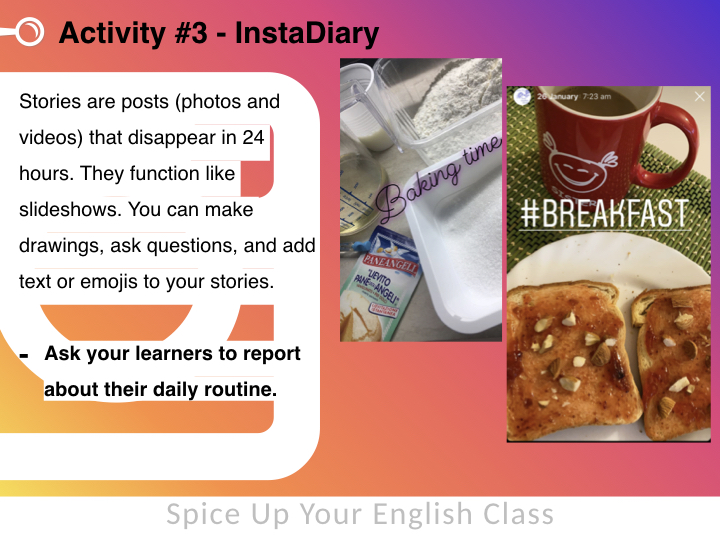
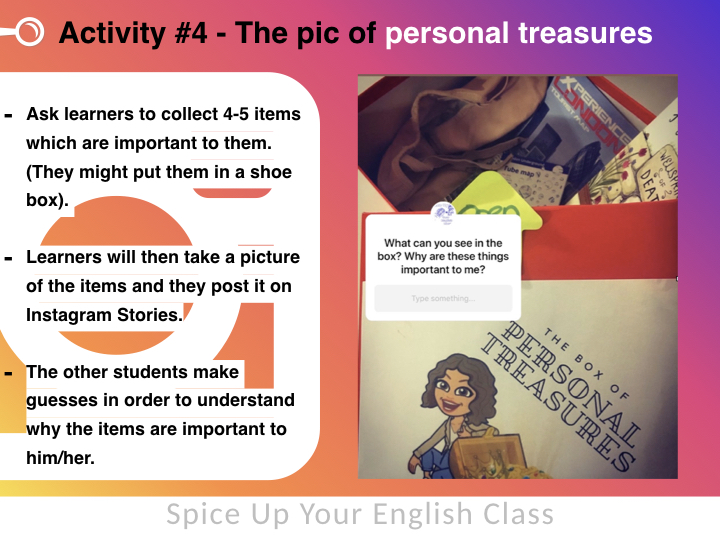
I presented 6 Instagram activities to engage teenagers. Here you are the slides!


Some of the teachers' caption were:
- Shall I change the 'autocertificazione' again?
- What's happening? What's all this noise?
- Can I go out?
- Who's knocking?


mercoledì 4 marzo 2020

Lost in London - A digital EFL Escape Classroom

Everyone is aware the coronavirus is having a dramatic impact on the world and governments are ordering or contemplating school closures in a bid to slow the spread of the virus. In this worrying scenario we cannot stop teaching our students, though. This is the reason why I created a digital EFL Escape Classroom. I know it is nothing like a real one, but it will take you and your learners on a virtual tour of London.


P.s. If you (student/teacher) want to take up Skype lessons with me, fill out this form!
P.s. 2 If you want me to run a digital EFL Escape Classroom online with your class, use the contact form.

lunedì 26 agosto 2019

Generation Z and Social Networking Apps: Back to School and Instagram

Some time ago I started my DipTesol independent research about the use of social networking apps to engage learners in communicative tasks inside and outside the EFL classroom. Last spring I also set up a closed Facebook group to share activities which include the use of social networks to learn English as a foreign language. 

Social scientists who study young people have found that their digital use can be inventive and even beneficial. This is true not just in terms of their social lives, but their education too. In fact, thanks to the online world, young people can now publish ideas not just to their friends, but to the world. And by writing for strangers, their sense of “authentic audience” makes them work harder, push themselves further, and create powerful new communicative forms.

One of the apps which is most used by young people in Italy and in Europe is Instagram, which is a social networking service built around sharing photos and videos. (If you want to know more about it, check this article.

It is almost time to start your lessons again and I know you are more than excited to meet your new and old students! I am also sure that you are looking for an activity which is not the usual 'What did you do last summer?', though. This the reason why I am going to share with you the following Bingo game.


RULES OF THE GAME

1. Distribute the cards and pens or pencils to each student.
2. Tell the players that they must interview each other. Have each player go around the group and ask other students questions.
3. When they find someone who replies positively to their question, they have to write down their name and then move on to another student for another question.
4. The student who first completes the grid with 9 different names, raises his/her hand and shouts, “Bingo!”
E.g. A: Did you use #summer and #beach?
B: Yes, I did.
A: Can you show me, please?
B: (Showing his/her Instagram account) Here you are.
A: (Writing down B's name) Thank you.

Download the template here. You will also find a blank template you can use to write down your own questions.

Have a wonderful back-to-school time!

Bye for now,
Larissa

Ps: If you use this activity, let me know your feedback please!
If you are interested in learning how to use social networking apps in your English classes, email me spiceupyourenglishclass@gmail.com.

sabato 6 ottobre 2018

Jenga in the EFL classroom

Hi everyone!

Here I am with another board game you can play in your EFL classroom!

Name: JENGA
Rules: http://www.jenga.com/about.php

In my opinion this game is great because it can be adapted to different levels and needs.
I used the following activities with my learners.

ACTIVITY 1
Level --> Beginner to Advanced
Age --> Teenagers/Adults
Type of activity --> Ice breaker
Skills practised --> Speaking and Listening

Before the lesson: 1. Put ice-breaking questions on the Jenga blocks.
2. You can either use labels or permanent markers.

During the lesson: 1. Each learner pulls a block.
2. They need to answer the question AND ask it to someone else.


ACTIVITY 2
Level --> Beginner to Advanced
Age --> Any
Type of activity --> Storytelling
Skills practised --> Vocabulary, Speaking, and Writing

Before the lesson: 1. Put words on the Jenga blocks.
2. You can either use labels or permanent markers.

During the lesson: 1. A learner pulls a block and starts a story using the word on that block.
2. The next student uses the word they pull to continue the story.
3. If the tower falls they need to quickly end the story.

In case you have a large class: While each learner comes to the front and continues the story, have the whole class write their own version using the blocks pulled.


ACTIVITY 3
Level --> Beginner to Advanced
Age --> Any
Type of activity --> Revision

Before the lesson: 1. Put numbers on the Jenga blocks.
2. You can either use labels or permanent markers.

During the lesson: 1. Divide the class in two teams.
2. Have two learners from each team come to the front of the class.
3. Ask one of the two students to pull a block.
4. Read out the corresponding question.
5. The first student to answer the question correctly can choose if they want to pull a block, or have the other team pull a block.
6. Once the next block is pulled, read out the question corresponding to that block.
7. The first team to make the tower fall loses.


ACTIVITY 4
Level --> Intermediate +
Age --> Teenagers/Adults
Type of activity --> Recognising minimal pairs
Skills practised --> Listening (Receptive pronunciation)

Before the lesson: 1. Put two different colours on the Jenga blocks.
2. Choose some minimal pairs to focus on, e.g. /iː/ /ɪ/

During the lesson:
1. Tell the class that each colour corresponds to a sound.
2. Read out a word.
3. A learner needs to pull the right block.
4. If the learner pulls out the wrong block, let them play again.


I'm sure you will have more ideas and I'd be pleased if you could share them.

martedì 14 agosto 2018

Hit The Target - A brain teaser for your summer holidays!

‘Tis the season to close books and put them away. Teachers and students alike are ready to set off on their summer holidays but wait, what about English?
Here you are a game you and your students can play under a beach umbrella!

Name of the game: Hit The Target 🎯
Level: B2 upwards
Age: teenagers, young adults, adults
The game can be played individually or in pairs.


Objective
Starting from the word indicated by the arrow, reach the center of the target by eliminating all the words included in it, which can be found in any ring, not necessarily in order, according to the rules below.

Rules

1) The word can be an anagram of the previous one.


2) It can be a synonym or an antonym of the previous one.


3) It can be a homophone (a word that is pronounced like another word but has a different spelling or meaning, for example some, sum /sʌm/) of the previous one.

4) It can be obtained by adding, removing, or replacing a letter in the previous one.


5)It can be associated to the previous one because of an idiom, collocation or saying.


6) It can form, together with the previous one, the name of a celebrity, or a place.


7) It can be associated to a work of art (book, theater, poetry, etc.), its author, or its title including any genre.


In your answer, you should explain and/or justify each association.

I made the one below for you, have fun and enjoy your summer holidays!


E.g. The first word is WILLIAM, the second word is PRINCE (Prince William), word number 3 is KISS because it's the title of one of Prince's songs.
Last but not the least, here you are template to create your own HIT THE TARGET! 


P.s. If you want to know all the answers, leave a comment! ;)

martedì 20 febbraio 2018

4 Ps to encourage teenagers to speak English in the classroom

What are the 4 Ps?
Presentation, planning, practice and participation.
Surely this acronym will remind you of the PPP paradigm which is a teaching approach describing the presentation of new language through  the 3 steps of Presentation (new language is presented to learners in order to make the form and meaning clear and memorable), Practice (the learners engage in concentrated controlled practice of the new language) and Production (the learners participate in simulated communication tasks). This form of language teaching has been fiercely criticized over the last few years. For instance, it is seen as a series of “products” that can be acquired as “accumulated entries”, but L2 acquisition is a “process” that is incompatible with teaching seen as the presentation and practice of a series of “products”. However, if the level of the students is low it is much better to introduce the target language in order to avoid the doom and gloom feeling in the classroom.

Why does it work well with teenager learners?
Teenagers, more than young children and adults, are afraid of being judged. According to the APA, American Psychological Association, (http://www.apa.org/monitor/apr07/teenage.aspx) a lot of teenage behaviour is about avoiding the anxiety of feeling left out. The four 'p's approach addresses that worry by the presence of the plan stage. Bear in mind, this stage does not correspond to the controlled practice of the PPP approach. By planning what they are going to say they have time to think and rehearse. This makes students feel more confident.
The activity I'm going to describe was successful because I divided it into four stages - present, plan, practice and participation.
Firstly, I acted as a student performing the task they were required to carry out, in this case a speaking activity. Secondly, students had some time think and take notes about what they were going to say. Thirdly, students started to speak in pairs in order to break the ice. Finally, we played a game so that everyone had the chance to revise the target language and have fun.

1) Presentation - model the target language
Although I am mindful of teacher talking time, learners need a model for inspiration. You are that model.
Just before Christmas holidays, I asked my class of teenager English learners:
'Guys, how do you usually spend Christmas Eve?'
Nobody answered. I smiled and I replied to the question myself. I said that I usually wake up late, I wrap presents for my family and friends, I watch Christmas movies on TV and I listen and sing Christmas carols, bake mince pies, etc.

While I was speaking I wrote some vocabulary on the board especially collocations such as wrap/unwrap presents, sing Christmas carols, bake cookies and asked the learners yes/no questions, for example, “Do you bake Christmas cookies?, Do you usually wrap presents?”.


2) Planning - give learners time to think about what they will say
Learners need time to plan before speaking, especially at a beginner/elementary level of proficiency.
I asked everyone to write notes about what they usually do on Christmas Eve. I checked their papers to see if their grammar and spelling were right and asked them to write their names on their papers. Then I stuck their papers on the classroom walls. I asked them to stand and walk around the classroom for five minutes to read about how their friends usually spend Christmas Eve.
Alternatively, teachers can ask learners to think about what they will say. Learners can also take notes. I suggest that they don’t write everything they want to say but only some words/phrases. This reduces the chances of learners reading - rather than saying - what they have written.

3) Practice - give learners a chance to say it and say it again
When the learners went back to their seats I paired them and I asked them to say to each other their Christmas Eve routines. After two minutes I asked them to change partner, and they repeated the activity until they talked to all the other students. When they showed more confidence and fluency while speaking, I thought they were ready to play a game.

4) Participation - RULES OF THE GAME
In turns one student seats on the “hot chair”
All the other students need to say a Christmas routine activity s/he does
If they are right they get one point.
Students cannot repeat routine that has already been mentioned.
If they repeat something which has already been said they lose one point.
Everyone had to speak about somebody’s else so no one was excluded from the speaking activity. They were all eager to speak and they had a lot of fun. In addition, they had to pay attention to what was being said. A game is, definitely, a good way to encourage teenage learners to participate. Games provide a task and a goal.

In a nutshell, tweaking a method which is not considered effective due to its lack of correspondence with the research findings and theories of second language acquisition gave me the chance to make my students learn and use effectively the target language. After all, as Machiavelli said, “ends justify the means”.

PS. You can use this game with daily routines, "what did you do yesterday?", likes & dislikes, etc.

martedì 11 aprile 2017

The dice game: a fun, low-prep speaking game

UPDATE: This blog post has been awarded the 'Blog Award for Innovative Teaching Ideas' by Teaching English British Council for the month of April 2017.

A fun game to revise the question form of past simple and of course... to speak 🇬🇧!!!

Level: elementary

Age of students: Children, teenagers, adults

Aim of the game: Practising past simple forms

What you need: a dice each 3 students

*You can adapt easily this game to meet your students' needs. For example, it can also be used to practise present simple and frequency adverbs.

Rules of the game
1) Think of 6 actions you did yesterday.
2) Write them down.
3) Work in groups of 3.
4) In turn, roll the dice and read out the sentence that corresponds to the number you got.
E.g. I roll the dice and I get 1. I read out the sentence "I ate fish and chips".
5) The other two learners in the group need to make up a suitable question for my answer.
E.g. Question by Maria: " What did you eat for lunch yesterday?"
Question by Francesco: "What did you eat for dinner yesterday?"
6) The student who rolled the dice decides which question is the most suitable for their answer. 
7) The learner(s) who guessed the correct question get(s) as many points as the spots on the face of the dice)
E.g. In this case Maria got 1 point because I had fish and chips for lunch.

Some feedback
My students and I loved this game because:
- it was a good way to drill the question form of past simple;
- they practiced irregular verbs;
- and finally, they got some points to become the best student of the month 😜

sabato 12 novembre 2016

Teaching for Exams? Have Fun! UNO Card Game

UPDATE: This blog post has been shortlisted for the 'Blog Award for Innovative Teaching Ideas' by Teaching English British Council.

Hello EFL teachers,

I am back with a new post for the "Teaching for Exams? Have Fun!" series!


I wanted my students to revise the following target language for their Cambridge First for Schools exam:
- phrasal verbs,
- collocations,
- grammar,
- idioms.
I didn't want to make them feel bored, though.

What did I come up with, then?

A card game, yes a card game!


Do you know UNO? If you don't, have a look here .

If you do, keep reading!

The rules of the game are the same as those of UNO except for the following additional rule: students need to make up a sentence using the target language on the card they are about to place.


If your students are training for the Cambridge First for Schools you can download my own deck of cards from this link or if you wish, edit them according to your needs (link)!


P.S. I played this game with a class of 6 students, if your class is larger you can divide them into small groups.  For example, for a 20 student class you can make up 2 groups of 10 so you only need to print out two decks of cards.


giovedì 17 marzo 2016

Household stuff: Great tools for teaching... grammar! Part 3

Hi everyone!
Welcome back to my series about using household stuff for teaching English as a foreign language!

Today's item is

 DRINKING STRAWS €1 (100 pcs)

PURPOSE: I used drinking straws to check my students' comprehension of COUNTABLE and UNCOUNTABLE "FOOD & DRINKS" NOUNS.

WHAT I DID BEFORE CLASS: - I printed out this template and I wrote down a food noun in each glass, then I cut each glass out. 
- I stuck two sheets of paper on the desk: 
1) COUNTABLE "FOOD & DRINKS" NOUNS
2) UNCOUNTABLE "FOOD & DRINKS" NOUNS

STUDENTS: (3-6) PRE-TEENS/TEENS/YOUNG ADULTS (A2 LEVEL)

WHAT I DID IN CLASS: After teaching a bunch of  COUNTABLE and UNCOUNTABLE "FOOD & DRINKS" NOUNS I told my students they were going to play a game and I showed them the drinking straws. I placed the "paper" glasses at a certain distance from the sheets. 

WHAT MY STUDENTS DID: All students stood up around the table and I told them the rules of the game.
Students took turns to blow into their drinking straw in order to make the "paper" glasses move towards/onto the right sheet.
They got one point for each right word and lost one point for each wrong one.


It was a very funny game and I felt especially satisfied with their positive results.
Watch the video: Drinking Straws - EFL game
Until the next item ;-)


mercoledì 9 marzo 2016

Household stuff: Great tools for teaching... exam classes! Part 2

Hi everyone!

Today's item is... 
ICE CREAM STICK
€1,50 (100 pcs)

PURPOSE: I used ice cream sticks to teach an exam-focused class. Students were trained to practise Cambridge FCE Reading and Use of English PART 4.   
[This part of the exam is called KEY WORD TRANSFORMATION. Each question consists of a sentence followed by a ‘key’ word and a second sentence with a gap in the middle. You have to use this key word to complete the second sentence so that it has a similar meaning to the first sentence.]

WHAT I DID BEFORE CLASS: I wrote some sentences on the ice cream sticks using present perfect simple/continuous and past simple. I wrote some sentences with the same meaning - using different tenses - and some "distractors'" which were wrong. 
E.g. Stick 1 --> My nephew began to play tennis in 2010.
Stick 2--> My nephew has been playing tennis since 2010.
Stick 3 --> My nephew has been played tennis since 2010.
The first two sentences have a similar meaning while the third one is wrong.

STUDENTS: (4-6) Teenagers

WHAT I DID IN CLASS: I told my students we were going to play a game to revise the use of PRESENT PERFECT SIMPLE/CONTINUOUS and PAST SIMPLE and I showed them the ice cream sticks in a clear plastic bag.
Afterwards, much to their surprise, I dumped the sticks on the desk. I said they had to pick up two sticks with the same meaning without moving the others. (See the rules of the game MIKADO)

WHAT MY STUDENTS DID: 
When they picked up two right sentences without moving the other sticks, they got 2 points.
When they picked up two right sentences moving one or more sticks, they got 1 point.
When they picked up a wrong sentence, they got no points.
They had a lot of fun!

Until the next item ;-)


mercoledì 2 marzo 2016

Household stuff: Great tools for teaching! Part 1

LOOK OUT! Even though this blogpost seems to be addressed to women only I'm sure male teachers will find it useful! 

WARNING: This is a very personal blogpost.

As you know (or if it's the first time you drop by, let me introduce myself) I teach English as a Foreign Language to children, teenagers and adults in a small seaside town (between Rome and Naples) where I was born. I'm in my early thirties (everyone says I look younger, though) and I'm not married.  "You should get married soon, or you'll be too old to have children" (Apparently everyone has watched/read Bridget Jones' Diary!)
Being unmarried at my age, especially in a small town, makes me feel like a suspicious person.
I spend most time teaching and when I'm off I love planning lessons and finding new teaching methods. This seems to be my greatest fault.  Ok... I plead guilty, Sir. 
"Well, what should I do?" I wondered. Showing more interest in household chores and cooking may help, I thought. So, a few weeks ago I tiptoed into a Houseware&Household shop near my language studio and I explored it. Unfortunately, once again I couldn't help but thinking of my lessons... 
I hope my ideas will appeal to you!

1) FLY SWATTER (€0,80 each) --> a plastic tool with a handle, used to swat (= hit) insects (www.oxfordlearnersdictionary.com)

1.1 Right or Wrong?
Materials: 2 fly swatters 
                 right/wrong sentences on sheets of paper
                (about) 8 magnets

Procedure: - I sticked on the board two sentences, one right and the other wrong.
                  - In pairs students came to the board and swatted the wrong sentence.
Comment: My teenager students practised the use of Contrasting Linkers (even though, despite, however, etc.)

1.2 Say... Swat it right!
Materials: 2 fly swatters
                 words about "the house" (any topic you want)
                 (about) 20 magnets
Procedure: - I sticked on the board five words about "the house".
                   - In pairs students came to the board.
              - I said a word in Italian (my students' native language") and students swatted the right word.              
Comments: It was a great way to revise vocabulary for lower-levels.

P.S. Be careful! Students might swat each other. Warn them beforehand that if they do so you will stop the game!
Until the next household item ;-)
                 

lunedì 1 febbraio 2016

Teaching for exam? Touch your students' hearts

Lately this video https://vimeo.com/152985022 has gone viral on social networks. I was so moved when I watched it for the first time that I decided to introduce it in my exam-oriented classes. Today I'd like to share with you the lesson plan I used for my Cambridge FCE (B2 level) which focuses mainly on developing speaking skills.

STUDENTS: Teenagers (b2)
TIME: 1h30
AIM: Learning vocabulary about free time activities
Developing speaking skills for the exam.

1) WARM-UP ACTIVITY: Write on the board The Present and ask your students:
What’s the best present you have ever received?
(Spice-it-up version: Show a present box and tell your students you just got a present. Let them predict what's in the box)
2) VIDEO ACTIVITY: WATCH, PREDICT, ANSWER
Tell your students you are going to watch a video whose title is The Present

Start watching the video. Stop it at 00:50, ask them:
What do you think is in the box?

Start the video again up to 1:10, ask them:
Why doesn’t he like the dog?

Continue up to 1:25, ask them:
What does the dog want to do?
How does the boy react?

Continue up to 2:00, ask them:
Does the dog find it easy to play with the ball?
Does it give up or keep on trying to catch it?

Continue up to 2:40, ask them:
Choose three adjectives to describe the dog in the video.
CUTE - SAVAGE - DETERMINED - DANGEROUS - SWEET - WILD - FRIENDLY

Continue up to 3:00, ask them:
What does the boy decide to do?

2a) FOCUS ON LISTENING
Watch the video again and answer the following questions:

What language function do these statements express?
“Hey sweety, sorry I got home so late.”
__________________________________________________________

“Why don’t you stop playing and open the present I got for you?”
___________________________________________________________

“Mom, we’ll be outside.”
____________________________________________________________

3) Teach VOCABULARY

- Pair/group up students and give them the set of paper strips below. (Cut them out before giving them)
- Give them two labelled plastic bags 1) indoor activities 2) outdoor activities and ask them to put the strips into the right bag. The activities which can be done in either places will be left outside the bags.

- Have feedback and explain new vocabulary.

4) SPEAK UP!

Show these two pictures and ask students to do the task above.

or SPICE IT UP: Put students in pairs and make them sitting back to back. Give each one of them a picture and this grid. Students take turn to speak about their picture and tick off the words/phrases from the grid used by their partner. In this way they will practise the skills mentioned above.

4a) SPEAK UP AGAIN...

PASS THE TENNIS BALL GAME
- Get a tennis ball or a small ball.
- Make the students sit in a circle.
- Tell them you are going to ask them some questions.
- Pass the ball to the first student and ask one of the questions below. The student, then, will choose another student to pass the ball to. The second student will say if they agree or disagree with the previous student and why.
- Let 4-5 students express their opinion for each question.

People say “ A trouble shared is a trouble halved”. Do you agree?
Have you ever helped a friend in trouble? What did you do?
Are dogs really man’s best friends?
In what ways are dogs helpful to humans?
Do you think some owners care too much for their dogs and not enough for other people?

6) Homework is fun!
There are some people who become unfriendly because they have a physical disability or a problem. Prepare an encouragement quote using
www.quotescover.com (WEB)
InstaQuote (iOS) - Kwote (Android)


martedì 5 gennaio 2016

Teaching for exams? Have fun! Give a pep talk to yourself and your mates!

A new year has just started and most of my students have their resolutions made: take an English language exam.
Studying for an exam is always considered boring and tiring, but let's spice up this hard-working task with a pep talk!

What is a pep talk?
According to the Merriam-Webster dictionary a pep talk is "a short speech that is given to encourage someone to work harder, to feel more confident and enthusiastic, etc."

Everyone needs a pep talk not only students who are taking an exam so this lesson plan can be useful for any type of class!

Students: TEENAGERS/ADULTS
Level: UPPER-INTERMEDIATE/ADVANCED
Time: 1h30minutes
Linguistic skills: LISTENING & SPEAKING

1) I started my class by writing the phrase PEP TALK on the board and asked my learners if they knew what it meant.
They brainstormed some ideas I reported on the whiteboard without saying whether they were right or wrong.
2) After a few minutes I told them I was going to show them a video about a pep talk so they could check their predictions.

This is the link to the video: A Pep Talk from Kid President to You
3) After watching the video I collected some feedback and I gave my students some information about Kid President.

4) Listening activity: I cut out the following sentences and paired up students. They watched the video again and put in order the sections as they heard them. (To check if they were right we watched the video with subtitles).


5) It's time to take action! Students have to prepare their own pep talks. I gave my learners the following instructions and tips:

My students' talks lasted about 60-90 seconds. They filmed each other and it took them about 30 minutes to write their speech.

6) Finally, students listened to each other's pep talk.

I found this class both heart-warming and encouraging. I hope you get the chance to try something similar with your learners and if you do, please let me know!


sabato 19 dicembre 2015

Merry Christmas!

I've been very busy with teaching my lovely students lately and I am looking forward to this Christmas break. Before my well-earned rest, though, I'd like to share with you a few games I prepared for Christmas. Have fun with your students, too!

Game 1
CHRISTMAS CHARADES
This is a Christmas-sentence guessing game. Basically, one player acts out a sentence about Christmas by miming similar-sounding words and the other players guess the sentence. 

Here you are the cards you can cut out.


Game 2
CHRISTMAS SENTENCE SCRAMBLE
On each piece of paper there is a word or phrase. Students need to create sentences which make sense.
Christmas sentence scramble 1
Christmas sentence scramble 2

Game 3
CHRISTMAS BOARD GAME
Get some candy ready for the winner!
RULES
1) Put your marker on the start position.
2) In turns, roll the dice and move your marker.
3) Answer the questions.
4) If you land on a "present" place you must spell a word.
[WORDS TO SPELL: ADVENT, PUDDING, TINSEL, FAIRY LIGHTS]
5) The first student to the last place is the CHRISTMAS STAR STUDENT!


*To enlarge the board you can use this website www.blockposters.com 

Have fun with your students!


venerdì 6 marzo 2015

Larissa and Inspector Z - Phrasal verbs with fun (part 3) COME

Ready for a new episode?
You will find the previous ones here

1) LOOK http://larissaslanguages.blogspot.it/2015/02/larissa-and-inspector-z-phrasal-verbs.html
2) GET http://larissaslanguages.blogspot.it/2015/02/larissa-and-inspector-z-phrasal-verbs_26.html

BEFORE YOU START - RECYCLE VOCABULARY
Ask your students to sum up the story so far in pairs.
Give them a list of the phrasal verbs which appeared in the previous episodes. They check the phrasal verbs off when they use them so they can realize how many they remember.


READING TASK - READ FOR THE GIST
1) What did James find?
2) What did he do?
3) What were Larissa and Inspector Z going to do?

LEARN NEW VOCABULARY  -  MATCHING ACTIVITY

SPEAKING TASK - PROBLEM SOLVING
Ask your students to come up with ideas about rescuing someone in pairs or in small groups.

Next week a new episode

giovedì 26 febbraio 2015

Larissa and Inspector Z - Phrasal verbs with fun (part 2)

Last week I created the first episode of the comics series "Larissa and Inspector Z" http://larissaslanguages.blogspot.it/2015/02/larissa-and-inspector-z-phrasal-verbs.html. My students and my followers enjoyed it so much that I decided to continue writing it.

This week the focus in on some phrasal verbs with GET.


How can you use it in class:

1) READING TASK - READ FOR THE GIST
 Give your students a copy of this comic strips and ask your students the following questions:
- Where was James?
- Who kidnapped him? Why?
- What did James feel like?

2) LEARN NEW VOCABULARY - MATCHING ACTIVITY


3) SPEAKING TASK - PREDICTING ACTIVITY
Ask your students what will happen next.
*They can also write their ideas on a board on www.padlet.com  so that next week will be able to check who was the nearest to the exact version.

4) HOMEWORK - FLASHCARDS CREATION
Students create flashcards with the meaning of the new phrasal verbs learnt using https://www.examtime.com/en/flash_card_decks/2139423/edit (free mobile app, too).

Next week a new episode!


giovedì 19 febbraio 2015

Larissa and Inspector Z - Phrasal verbs with fun

In order to teach my upper-intermediate students some phrasal verbs useful for their Cambridge FCE exam I decided to create a comic series. Larissa and Inspector Z is a comic series which is useful for teaching and learning phrasal verbs in context with fun. I got inspired by the amazing Sylvia Guinan who wrote a post about using storytelling for teaching exam classes. http://www.slideshare.net/thalassini2013/interactive-story-telling-for-english-exams-final.
How can you use it in class:
1) Give your students a copy of this comic strips and ask your students to answer the following questions:
- Why did Larissa visit Inspector Z?
- What happened to James?
- What did Inspector Z find out?

2) In pairs students will try to work out the meaning of the six phrasal verbs. 
Get feedback from students. Write the phrasal verbs on the board with their definition/meaning so that everyone can see them.

3) Students predict what will happen next.

4)Homework: Students write sentences using the TL.


Next week a new episode!

lunedì 12 gennaio 2015

The power of free mobile apps - No 1 PicCollage

Dear followers,

Happy New Year! 

I am so glad to be back! I'd like to start this new year with a new series of posts. If you have been following my blog for a while you will certainly know I love teaching by using both tech and daily life objects, that's why I am going to share with you my classroom experiences and ideas about a free mobile apps every month. 

Free mobile app No 1


Description from Itunes

"PicCollage is THE coolest collage-maker in town! Join 80 million people who use PicCollage to combine photos, Youtube videos, funky fonts, sassy stickers and cute cutouts to create the prettiest collages you'll ever see on a mobile device. We have stickers from Maroon 5, Beats Music, Universal Pictures, and LA-based independent designer, Sara M. Lyons. Check out our Contests section and create a visual response instead of just a plain text response. Share with your friends and followers on Instagram, Facebook, Twitter, and iMessage. You can also PRINT your collages into greeting cards or postcards to send to your loved ones anywhere in the world!"
Activity 1
Warm-up/Ice-breaker activity - level beginner
Ask learners to take pictures of the things around the classroom or the school they already know and then label them.
E.g. 

Activity 2 
Free practice (homework) - level elementary
After teaching countable & uncountable food nouns I asked my learners to take pictures of food items they had in their house. I asked them to create two different collages: one for countable nouns and the other for uncountable nouns.
This activity gave me the chance to check whether my learners had really understood the difference between countable & uncountable nouns since in their native language the distinction is not the same.
In this example one of my learners took pictures of countable nouns but as you can see there are three items which have uncountable nouns. 
How to give my learner effective feedback?
I shared this picture with all the other students without saying who had taken it. I told them that the collage was about countable nouns but there were three odd ones and they had 3 minutes to find them out. They worked in pairs and then we had collective feedback.

Activity 3 
Exam-oriented activity - Cambridge First for Schools (B2 level) Speaking part 2
From the Cambridge website - "The examiner gives you two photographs and asks you to talk about them. You have to speak for 1 minute without interruption and the interlocutor then asks the other candidate to comment on your photographs for about 30 seconds. The other candidate receives a different set of photographs and you have to listen and comment when they have finished speaking. The question you have to answer about your photographs is written at the top of the page to remind you what you should talk about."

As homework I asked my learners to take two pictures of people who were learning and put them together with PicCollage. When they came to the lesson I printed the pictures out and they swop the photos they had taken and they answered the following question:

What are the advantages of learning in these different ways?


If you have other ideas I will be pleased to add them here!


lunedì 24 novembre 2014

My first workshop and webinar - Experiences I want to make again and again

In the last few weeks I was really busy with my lessons but I made time for my first workshop and webinar.

1) Workshop - Teaching Teenagers: 4 Skills + 1 at the TESOL Italy's 39th National Convention

In this workshop I talked about how we can engage teen learners and how to create fun lesson plans which integrate the four linguistic skills, and at the same time, allow the students to learn job skills. I shared with the audience my series of lessons called "If I were a... JOB". The example I used was If I were a... mayor. 
However, before handing out my own lesson plan I showed them this slide and I asked to create their own lesson plan. While they were working in small groups I supervised and I noticed that the most difficult part was to integrate the skills with the aims. So I told them, "Be creative, don't be afraid of trying something new and you'll see that you and your students will have a lot of fun"!

Over the last few lessons my teen students and I have also tried out to be TV reporters and real estate agents and I hope to share my lesson plans soon with you. 

2) Webinar - Games in the English classroom hosted by Jason R Lavine (Fluency MC) and WizIQ.

I'd never been fond of teaching online because I'd always thought it was not my cup of tea but yesterday I completely changed my mind. I'd always believed I couldn't have enough interaction with the audience in a webinar but I was terribly wrong! Yesterday I had the chance to meet teachers from any part of the world and I was able to share my ideas with them. Moreover, at the end of webinar some of them even contacted me on social networks and we continued our conversation about teaching issues. 

I loved having this webinar also because I could talk about something I usually do with my students in my language studio. Playing games is so important to me because they add variety to the lesson, they make students feel relaxed and less worried about mistakes and finally we have a lot of fun!

If you wish to see the slides and the webinar recording please enroll here ;-)

I'd like to thank once again Jason for giving me this fantastic chance and introducing me to the world of online teaching!


sabato 13 settembre 2014

#100happylearningenglishdays - a challenge to improve English through social media

If you like me teach adults you are certainly used to hearing something like, "I need to learn English, but I don't have enough time".

A few days ago I ran into this website http://100happydays.com whose slogan is 
and I immediately thought about my adult students who are always in a hurry when it comes to learning English. Why not challenge them to learn English for 100 days in a row? 

In order to take part to the #100happydays challenge people must take pictures of what makes them happy day by day and share it via Facebook, Twitter or Instagram.

As far as learning English is concerned there might be several types of challenges according to the level and the needs of the students.
I came up with the following ideas.


#1 Vocabulary - Students can take pictures of daily life items in order to learn their names.
CHAIR

#2 Grammar - Students can write the paradigms of irregular verbs. (E.g. TAKE-TOOK-TAKEN)

#3 Phrasal verbs - Students can write a new phrasal verb together with its meaning and an example. (They might add a picture if they want to.)
#4Idioms - Students can write a new idiom together with its meaning and an example. (They might add a funny picture.)
http://kaplaninternational.com/blog/english-idioms-time/
#5 Functional language - Students can write a question or a sentence that is useful for their communication with other people such as inviting someone to do something, suggesting something, apologising, etc. E.g. DO YOU FANCY GOING TO THE CINEMA TONIGHT? (Maybe someone will reply and you will spend a great night out :) )

Why do I think it can work with a huge number of students?
People aged between 18 and 44 use social media more and more. They love to catch up with family and friends, share their experiences and feelings. In this way, learning English can be something that will make them feel cool.

What are the drawbacks of this challenge?
In my opinion students might be fed up with it after a week. Also the 100happydays website states that 71% of people failed to complete the challenge.

I hope my students and your students will love this challenge and will be able to win it!
Prize them with this certificate! 

If you can think of any other ideas for this challenge, please share it with me!

P.S. Always remember to use #100happyenglishlearningdays

P.S.2 I have used this challenged with teenagers, too. It was super! :)