Hi everyone,
I know coronavirus is what you expected I was going to talk about today, but no, I won't. There is a lot of going on already and I'm not a medicine expert.
I'd like to share with you a lesson plan I created some time ago for my DipTesol teaching practice. I used it with B2 adult learners but it can work with teenagers, too.
I was inspired by this article https://www.dailymail.co.uk/news/article-2200185/Top-50-embarrassing-moments-revealed.html and this viral video https://www.youtube.com/watch?v=p8nFR4sXkFE .
The objective of the lesson was to enable Ls to talk about an embarrassing moment in their/someone’s lives.
Here you will find the lesson stages, https://drive.google.com/file/d/1bsPdu1cZT3yFO_okh7IRjiGMhx2vkLEh/view?usp=sharing
and these are the materials I used
https://drive.google.com/file/d/1j2tuX4jr3zeuy4U8IfMIeVTEM0FNPrKS/view?usp=sharing
https://drive.google.com/file/d/1opExPAk55C1YPSl4vL0bnp1mR6BB8U7o/view?usp=sharing .
Let me know if this lesson plan has worked with your students too!
Ps. If you (student/teacher) want to take up Skype lessons with me, fill out this form!
Visualizzazione post con etichetta adults. Mostra tutti i post
venerdì 28 febbraio 2020
lunedì 10 dicembre 2018
POINT YOUR FINGER: a game my adult learners really enjoy
A few weeks ago I gave one of my workshops for teachers about how to use games in order to teach English as a foreign language. Only one of the participants didn’t show interest at all, and yes I took it at heart. I approached the neglectful lady while everyone in her group was focused on the task and she was phubbing instead. ‘I don’t want to sound rude but’, I began. She looked up, glanced at me then looked down back to her smartphone. I hesitated but then I continued, ‘Don’t you like this game? In the next session there will be more exciting activities, don’t wor…’, ‘I don’t care at all, my boss paid for this course but I teach adults, professionals, business people, I have nothing to do with snotty kids’, she cut me off. Well, at that very moment the angel me and devil me started arguing. ‘Move on to the next group and try to be helpful’, ‘No way, she insulted all your theories you should show off your knowledge about how powerful games are for adults when it comes to learning’. As you know (or you don’t), I chose to follow my angel me’s advice and I carried on with my monitoring activity’.
That evening, on my way back home, I couldn’t help but wonder, ‘ Why do so many people still think that games are only for kids? And more importantly, what’s wrong with adults playing games?’
I’m sure that adult students’d better let their hair down after a long day at work rather than being in the spotlight if they got an irregular past simple wrong. Especially professionals and business people who are always under pressure benefit more when they learn in a playful environment.
There is no doubt that children’s learning process is way too different from the one of adults but a playful activity has never harmed anyone. There are games for children and games for adults, there are games for children which can be adapted for adults. There are games adults like and games they do not like but that doesn’t depend on the fact that playful activities are only for kids but because the structure or goal of the game isn’t interesting/exciting enough.
This is the reason why I’d like to share with you one of the games my adult students enjoyed most.
GAME: Point your finger
LEVEL: Intermediate - upwards
LINGUISTIC SKILLS: Speaking/Listening
GRAMMAR FOCUS: Have you ever + Past participle?
Present perfect VS Past simple
NUMBER OF PLAYERS: 4-6 p/group
WHAT YOU NEED: 1. A set of ‘Have you ever…?’ cards
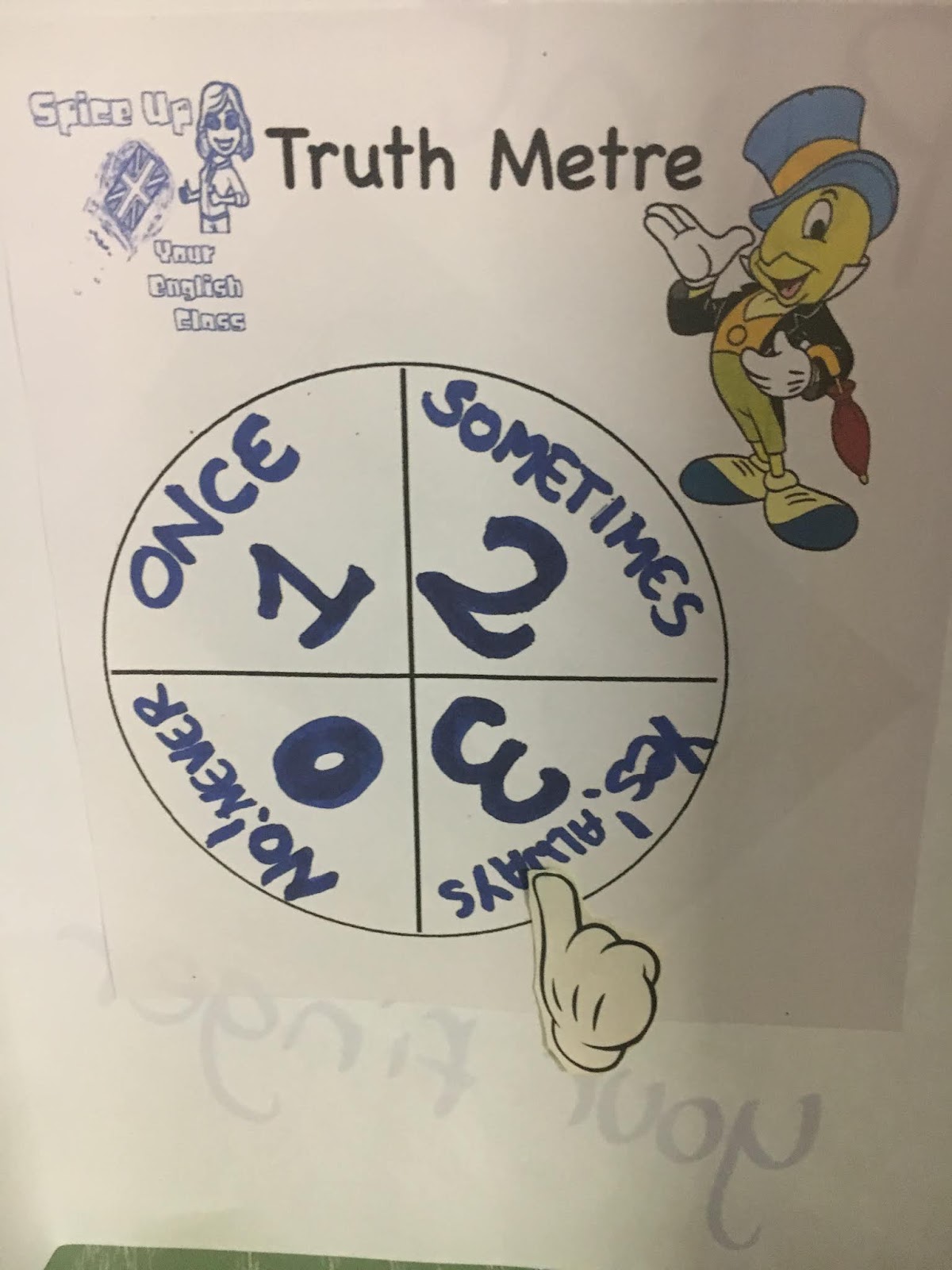
2. A truth metre and sticker finger for each student. (Tips: 1. Fold an A4 paper in 3 parts so that the truth metre cannot be seen by the other students. 2. Use a sticky note to make the finger.)
RULES: 1. Ask one of the students to pick a ‘Have you ever…?’ card and read out the question.
2. Everybody (including the student who has read out the question) needs to stick the finger onto one of the four options:
0=never
1=once
2=sometimes
3=always
(Students need to be careful not to show their answer.)
| 'Truthmetre' |
3. When everybody has answered (I suggest that you set a time limit), ask students to point their own finger at the person they think has answered 3 (always).
4. Start to check the answers by asking the student pointed by the one who read the question and then continue clockwise.
5. The students who have pointed to the ones who have answered 3 win 3 points, those who have pointed to the students who have answered 2 win 2 points and so on.
When I played this game for the first time I was amazed because when a student said, ‘0’, she couldn’t stop talking, she had to explain about her answer because the students who had pointed at her wanted to know why she answered ‘never’. Honestly, all the students talked a lot because they were eager to share their personal experience, I had to stop them talking!
It was such a pleasure to see them speaking English and having fun.
Thus, ‘fingerly'-speaking, thumbs up for games, all the time… all ages!
domenica 14 febbraio 2016
Valentine's Day: LOVE collocations and QR codes
Here it comes Valentine's Day, the day we celebrate all types of love! Why don't teach/learn some LOVE collocations?
1) Print out the worksheet with the collocations.
2) Print and cut out the QR codes and stick them up around the classroom.
3) Students use a QR scanner app to read the definitions and then they copy them below the collocation (on the envelopes).
4) Have fun and lots of love ;)
martedì 5 gennaio 2016
Teaching for exams? Have fun! Give a pep talk to yourself and your mates!
A new year has just started and most of my students have their resolutions made: take an English language exam.
Studying for an exam is always considered boring and tiring, but let's spice up this hard-working task with a pep talk!
What is a pep talk?
According to the Merriam-Webster dictionary a pep talk is "a short speech that is given to encourage someone to work harder, to feel more confident and enthusiastic, etc."
Everyone needs a pep talk not only students who are taking an exam so this lesson plan can be useful for any type of class!
Students: TEENAGERS/ADULTS
Level: UPPER-INTERMEDIATE/ADVANCED
Time: 1h30minutes
Linguistic skills: LISTENING & SPEAKING
1) I started my class by writing the phrase PEP TALK on the board and asked my learners if they knew what it meant.
They brainstormed some ideas I reported on the whiteboard without saying whether they were right or wrong.
2) After a few minutes I told them I was going to show them a video about a pep talk so they could check their predictions.
This is the link to the video: A Pep Talk from Kid President to You
3) After watching the video I collected some feedback and I gave my students some information about Kid President.
4) Listening activity: I cut out the following sentences and paired up students. They watched the video again and put in order the sections as they heard them. (To check if they were right we watched the video with subtitles).
5) It's time to take action! Students have to prepare their own pep talks. I gave my learners the following instructions and tips:
My students' talks lasted about 60-90 seconds. They filmed each other and it took them about 30 minutes to write their speech.
6) Finally, students listened to each other's pep talk.
I found this class both heart-warming and encouraging. I hope you get the chance to try something similar with your learners and if you do, please let me know!
Studying for an exam is always considered boring and tiring, but let's spice up this hard-working task with a pep talk!
What is a pep talk?
According to the Merriam-Webster dictionary a pep talk is "a short speech that is given to encourage someone to work harder, to feel more confident and enthusiastic, etc."
Everyone needs a pep talk not only students who are taking an exam so this lesson plan can be useful for any type of class!
Students: TEENAGERS/ADULTS
Level: UPPER-INTERMEDIATE/ADVANCED
Time: 1h30minutes
Linguistic skills: LISTENING & SPEAKING
1) I started my class by writing the phrase PEP TALK on the board and asked my learners if they knew what it meant.
They brainstormed some ideas I reported on the whiteboard without saying whether they were right or wrong.
2) After a few minutes I told them I was going to show them a video about a pep talk so they could check their predictions.
This is the link to the video: A Pep Talk from Kid President to You
3) After watching the video I collected some feedback and I gave my students some information about Kid President.
4) Listening activity: I cut out the following sentences and paired up students. They watched the video again and put in order the sections as they heard them. (To check if they were right we watched the video with subtitles).
5) It's time to take action! Students have to prepare their own pep talks. I gave my learners the following instructions and tips:
6) Finally, students listened to each other's pep talk.
I found this class both heart-warming and encouraging. I hope you get the chance to try something similar with your learners and if you do, please let me know!
venerdì 6 marzo 2015
Larissa and Inspector Z - Phrasal verbs with fun (part 3) COME
Ready for a new episode?
You will find the previous ones here
1) LOOK http://larissaslanguages.blogspot.it/2015/02/larissa-and-inspector-z-phrasal-verbs.html
2) GET http://larissaslanguages.blogspot.it/2015/02/larissa-and-inspector-z-phrasal-verbs_26.html
BEFORE YOU START - RECYCLE VOCABULARY
Ask your students to sum up the story so far in pairs.
Give them a list of the phrasal verbs which appeared in the previous episodes. They check the phrasal verbs off when they use them so they can realize how many they remember.
READING TASK - READ FOR THE GIST
1) What did James find?
2) What did he do?
3) What were Larissa and Inspector Z going to do?
LEARN NEW VOCABULARY - MATCHING ACTIVITY
SPEAKING TASK - PROBLEM SOLVING
Ask your students to come up with ideas about rescuing someone in pairs or in small groups.
Next week a new episode
Etichette:
activity,
adults,
comics,
exams,
fce,
phrasal verbs,
teachers,
teenagers,
vocabulary
giovedì 19 febbraio 2015
Larissa and Inspector Z - Phrasal verbs with fun
In order to teach my upper-intermediate students some phrasal verbs useful for their Cambridge FCE exam I decided to create a comic series. Larissa and Inspector Z is a comic series which is useful for teaching and learning phrasal verbs in context with fun. I got inspired by the amazing Sylvia Guinan who wrote a post about using storytelling for teaching exam classes. http://www.slideshare.net/thalassini2013/interactive-story-telling-for-english-exams-final.
How can you use it in class:
1) Give your students a copy of this comic strips and ask your students to answer the following questions:
- Why did Larissa visit Inspector Z?
- What happened to James?
- What did Inspector Z find out?
2) In pairs students will try to work out the meaning of the six phrasal verbs.
Get feedback from students. Write the phrasal verbs on the board with their definition/meaning so that everyone can see them.
3) Students predict what will happen next.
4)Homework: Students write sentences using the TL.
Next week a new episode!
lunedì 24 novembre 2014
My first workshop and webinar - Experiences I want to make again and again
In the last few weeks I was really busy with my lessons but I made time for my first workshop and webinar.
1) Workshop - Teaching Teenagers: 4 Skills + 1 at the TESOL Italy's 39th National Convention
In this workshop I talked about how we can engage teen learners and how to create fun lesson plans which integrate the four linguistic skills, and at the same time, allow the students to learn job skills. I shared with the audience my series of lessons called "If I were a... JOB". The example I used was If I were a... mayor.
However, before handing out my own lesson plan I showed them this slide and I asked to create their own lesson plan. While they were working in small groups I supervised and I noticed that the most difficult part was to integrate the skills with the aims. So I told them, "Be creative, don't be afraid of trying something new and you'll see that you and your students will have a lot of fun"!
Over the last few lessons my teen students and I have also tried out to be TV reporters and real estate agents and I hope to share my lesson plans soon with you.
2) Webinar - Games in the English classroom hosted by Jason R Lavine (Fluency MC) and WizIQ.
I'd never been fond of teaching online because I'd always thought it was not my cup of tea but yesterday I completely changed my mind. I'd always believed I couldn't have enough interaction with the audience in a webinar but I was terribly wrong! Yesterday I had the chance to meet teachers from any part of the world and I was able to share my ideas with them. Moreover, at the end of webinar some of them even contacted me on social networks and we continued our conversation about teaching issues.
I loved having this webinar also because I could talk about something I usually do with my students in my language studio. Playing games is so important to me because they add variety to the lesson, they make students feel relaxed and less worried about mistakes and finally we have a lot of fun!
If you wish to see the slides and the webinar recording please enroll here ;-)
I'd like to thank once again Jason for giving me this fantastic chance and introducing me to the world of online teaching!
Etichette:
activity,
adults,
board games,
english,
exams,
learners,
PLN,
seminars,
teachers,
webinars,
workshops
sabato 13 settembre 2014
#100happylearningenglishdays - a challenge to improve English through social media
If you like me teach adults you are certainly used to hearing something like, "I need to learn English, but I don't have enough time".
A few days ago I ran into this website http://100happydays.com whose slogan is
and I immediately thought about my adult students who are always in a hurry when it comes to learning English. Why not challenge them to learn English for 100 days in a row?
In order to take part to the #100happydays challenge people must take pictures of what makes them happy day by day and share it via Facebook, Twitter or Instagram.
As far as learning English is concerned there might be several types of challenges according to the level and the needs of the students.
I came up with the following ideas.
#1 Vocabulary - Students can take pictures of daily life items in order to learn their names.
![]() |
| CHAIR |
#2 Grammar - Students can write the paradigms of irregular verbs. (E.g. TAKE-TOOK-TAKEN)
#3 Phrasal verbs - Students can write a new phrasal verb together with its meaning and an example. (They might add a picture if they want to.)
#4Idioms - Students can write a new idiom together with its meaning and an example. (They might add a funny picture.)
![]() |
| http://kaplaninternational.com/blog/english-idioms-time/ |
#5 Functional language - Students can write a question or a sentence that is useful for their communication with other people such as inviting someone to do something, suggesting something, apologising, etc. E.g. DO YOU FANCY GOING TO THE CINEMA TONIGHT? (Maybe someone will reply and you will spend a great night out :) )
Why do I think it can work with a huge number of students?
People aged between 18 and 44 use social media more and more. They love to catch up with family and friends, share their experiences and feelings. In this way, learning English can be something that will make them feel cool.
What are the drawbacks of this challenge?
In my opinion students might be fed up with it after a week. Also the 100happydays website states that 71% of people failed to complete the challenge.
I hope my students and your students will love this challenge and will be able to win it!
Prize them with this certificate!
If you can think of any other ideas for this challenge, please share it with me!
P.S. Always remember to use #100happyenglishlearningdays
P.S.2 I have used this challenged with teenagers, too. It was super! :)
P.S. Always remember to use #100happyenglishlearningdays
P.S.2 I have used this challenged with teenagers, too. It was super! :)
giovedì 21 agosto 2014
Back to teach - Ready for a new adventure
After a long time here I am back again. My dream about having a larger studio where my students and I could feel more comfortable has just come true.
In a couple of weeks I am going to take up my lessons again and I'm ready to share my ideas and experiences with you, my dear followers.
During the summer I went on picking up new strategies, approaches and methods.
I read some interesting (e)books such as The Practice of English Teaching from which I learnt more and more about how to teach the four linguistics skills and Learning to Go by Shelly Sanchez. If you like me love teaching by using mobile device you must read it, you will get fantastic ideas.
Plus, I attended most of the excellent webinars hosted by the iTDi Summer School MOOC for English Teachers.
I was impressed by Shelly and Sylvia Guinan who inspired me a lot in their session about being an EduHero. I totally agree with them when they say we are model heroes our students must follow to get better and better results not only in learning English but also in all the other aspects of their lives.
In Shelly's words,
.png)
"It is important as EduHeroes that we inspire our students to also go on heroic journeys. We need our learners to feel like heroes, that it is their duty to care about the world. We need to inspire them to learn math, science, languages, writing, and literacy not to take tests, but because by obtaining these skills along their hero journeys they will be able to find cures, get closer to living in a peaceful world, lead meaningful lives, and solve world issues like hunger, poverty, and illiteracy. The only way that we will raise heroes is if we, their teachers, impart to them this mission and let them know we believe that each one of them has the ability and strength to be a hero if they just choose to endure the journey and learn the skills".
We share our mission/adventure with our students because teaching and learning can't exist without each other. Our human touch is crucial because students are individuals and we have to treat them with care and respect. We need to support them in their learning adventure with patience without getting angry or upset with them if they cannot achieve their goals immediately.
Learning means loving, getting involved, trying, making mistakes, falling down and getting back up again.
For this reason I'd like to dedicate this song to my past, present and future students. Are you ready for a new adventure? I am ;-)
Iscriviti a:
Post (Atom)