Visualizzazione post con etichetta teenagers. Mostra tutti i post

domenica 31 maggio 2020

My Teaching Reflections - Differentiation

Over the last few months I have been busy teaching online. I have learnt lots of new things about teaching and learning and I have decided to create a new series of blogposts about my teaching reflections in which I will give practical tips and hacks and suggest some reading about the topic I am dealing with each time. I will follow the KISS 💋 rule - I will Keep my posts Short and Simple in order not to get you bored.

👩‍🏫 👨‍🏫Differentiation is not discrimination.

▶️When students are assigned different tasks, they are not concerned about the task itself but the
reason behind that allocation - we, teachers, should communicate to ‘less confident learners that our aim is to find ways to include them in the lesson’.

▶️ Inclusiveness and togetherness play an essential role in classroom dynamics - it is advisable not to use differentiated activities at the beginning/end of the lesson.

▶️ Dominant learners tend to shout 🗣 their answers, talk over one another and interrupt other students. On the other hand, less confident students will assume a passive role. Especially during online lessons they just mute their microphones 🤐. The ‘random tool’ (a feature you can find in https://www.classdojo.com or you can make on your own by simply using lollipop sticks) gives all the students an equal opportunity to answer questions.

The book 📖 I recommend today is:
Mixed-Ability Teaching by Dudley and Osváth.

You can find it here.


That’s all folks!

Bye for now,
Larissa

P.s. If you (student/teacher) want to take up Skype lessons with me, fill out this form!

domenica 29 marzo 2020

EFL Talks Italy 29.3.20 - 6 Engaging Instagram Activities for Teens

Some weeks ago we started our lockdown due to COVID-19 in Italy. Teachers had been obliged to move to online teaching; students and teachers alike had to get used to completely new way of teaching/learning. I read several posts on Facebook about how difficult it was so I got in touch with Rob Howard who is the creator of http://www.efltalks.com. (Take a look at this great website).
He came up with the fantastic idea of holding an EFL Talks event all dedicated to Italian English-language teachers.

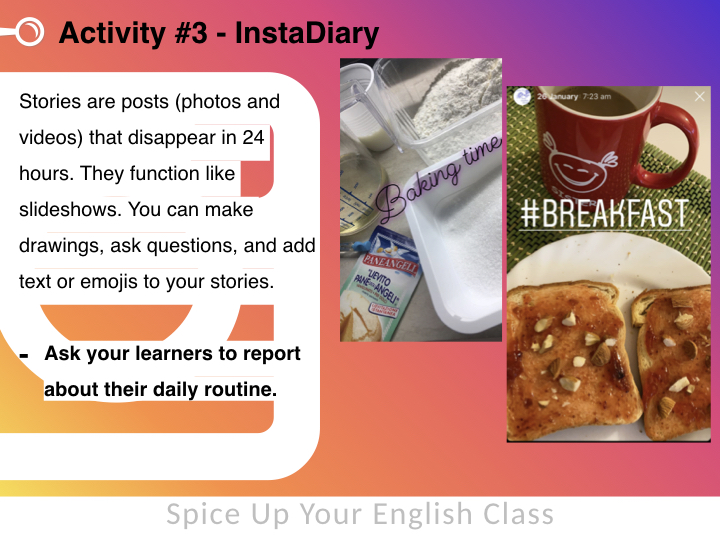
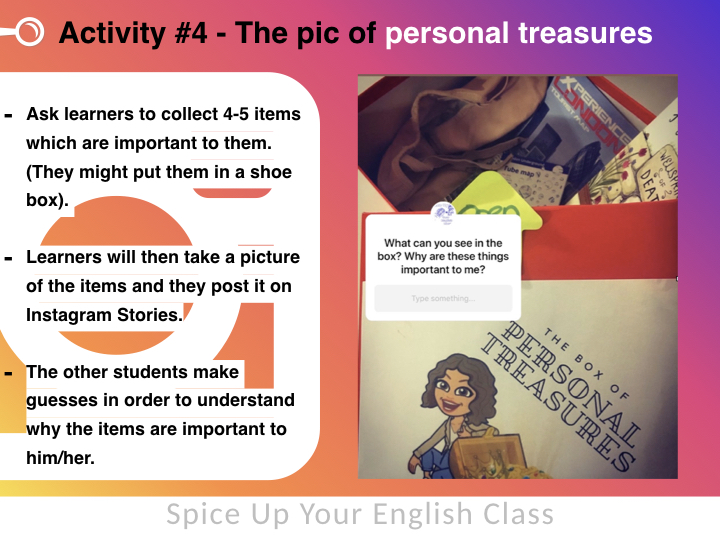
I presented 6 Instagram activities to engage teenagers. Here you are the slides!


Some of the teachers' caption were:
- Shall I change the 'autocertificazione' again?
- What's happening? What's all this noise?
- Can I go out?
- Who's knocking?


mercoledì 4 marzo 2020

Lost in London - A digital EFL Escape Classroom

Everyone is aware the coronavirus is having a dramatic impact on the world and governments are ordering or contemplating school closures in a bid to slow the spread of the virus. In this worrying scenario we cannot stop teaching our students, though. This is the reason why I created a digital EFL Escape Classroom. I know it is nothing like a real one, but it will take you and your learners on a virtual tour of London.


P.s. If you (student/teacher) want to take up Skype lessons with me, fill out this form!
P.s. 2 If you want me to run a digital EFL Escape Classroom online with your class, use the contact form.

venerdì 28 febbraio 2020

When was the last time you went red-faced? A lesson plan about embarrassing moments

Hi everyone,

I know coronavirus is what you expected I was going to talk about today, but no, I won't. There is a lot of going on already and I'm not a medicine expert.

I'd like to share with you a lesson plan I created some time ago for my DipTesol teaching practice. I used it with B2 adult learners but it can work with teenagers, too.
I was inspired by this article https://www.dailymail.co.uk/news/article-2200185/Top-50-embarrassing-moments-revealed.html and this viral video https://www.youtube.com/watch?v=p8nFR4sXkFE .

The objective of the lesson was to enable Ls to talk about an embarrassing moment in their/someone’s lives.

Here you will find the lesson stages, https://drive.google.com/file/d/1bsPdu1cZT3yFO_okh7IRjiGMhx2vkLEh/view?usp=sharing 
and these are the materials I used
https://drive.google.com/file/d/1j2tuX4jr3zeuy4U8IfMIeVTEM0FNPrKS/view?usp=sharing 
https://drive.google.com/file/d/1opExPAk55C1YPSl4vL0bnp1mR6BB8U7o/view?usp=sharing .

Let me know if this lesson plan has worked with your students too!

Ps. If you (student/teacher) want to take up Skype lessons with me, fill out this form!

martedì 18 febbraio 2020

'Station Squabble': a picture-telling activity

Hi folks,

here I am again with a new teaching idea I came up with thanks to a photograph which went viral last week. I'm talking about the shot 'Station Squabble' which has made Sam Rowley win the Wildlife Photographer of the Year LUMIX People's Choice award. Apparently Sam spent late nights at a central London tube stop, down on his belly trying to get the perfect low-angle view. His two subjects had been foraging separately until they chanced across the same morsel of food. For a split second, they argued over who should have it before then going their separate ways.
If you haven't seen the picture yet, I am sure your curiosity has been aroused. I'm not going to show you the photo now, though, I'd like to share my lesson plan first!


Level: A2
Age: Pre-teens/Teens
Target language: Cohesive devices - Substitution/Ellipsis + Sentence stress

Procedure:
1. Warm-up activity - Call My Bluff
Board the phrase 'Station Squabble', most Ls at this level will struggle to understand the meaning of 'squabble' so you can play the game Call My Bluff.
Provide Ls with three/four definitions of the word squabble, but only one of them must be correct ('an argument over something that is not important' - www.dictionary.cambridge.com).
Ls in pairs/small groups guess which the correct definition is through a poll activity. (If you're a tech-savvy teacher, you might use this website.)

2. Self-assessment
Without telling Ls which definition is the correct one, ask them to read a short dialogue which is an example of a 'squabble' that really happened between two friends. This task will get Ls to understand whether their answers were right or wrong and avoid direct teacher's corrective feedback.
3. Working on the text
Ask Ls to work in pairs.
a. Ls decide which word is missing in the first line. 
b. Ls describe the two characters (whose name is the same).

4.a Focus on TL
Ask Ls work in small groups.
a. Ls try to explain the difference between 'my' and 'mine'.
b. Ls say which word 'did' replaces.

Substitution involves some linguistic item substituting for another item occurring in the prior linguistic context.

Ellipsis is like Substitution except that it involves deleting information recoverable from some prior context rather than replacing the information with a word like do or so. (Meyer, 2002)

4.b Focus on Phonology - Sentence stress
We know that grammar words are usually unstressed. However, in this short dialogue they are. Drill the sentences focusing on the stress by using bullets on the words which are 'strong'. 


5. Showing the photograph
It's time to show the photograph! 
Tell Ls you have a picture of the squabble you've been talking about. Show it to your students and they check out their predictions.
Sam Rowley/Wildlife Photographer of the Year

The word missing is 'food'; the phrase 'food morsel' is correct, too. 


domenica 12 gennaio 2020

GenZ and viral papal slap: teaching ideas

It’s been ages since last time I blogged. One of my new year’s resolutions is to be more ‘social’ and share my teaching ideas, so here I am! Back to tell you about my class experiences. 
At the moment I’m working with teenagers (mainly) at ‘Liceo’ in South Italy and I find it really interesting and exciting teaching Generation Z. If you are wondering about who Generation Z members are like, well, let me give you a quick description about two of their main features. 

GenZ - Open-minded people with a witty sense of humour
According to Seemiller & Grace (2019) more than 70% of today’s teenagers have described themselves ‘as loyal, thoughtful, determined, compassionate, open-minded and responsible’. The word that most caught my attention was open-minded and Seemiller & Grace go on saying that ‘their open-mindedness may help them look at situations and issues from multiple perspectives and in unconventional ways’.  Moreover, ‘growing up alongside YouTube, the hub of entertaining videos, it makes sense that those in Generation Z would seek out and use humour as a way to balance the more serious concerns they have in life’. The other day I was able to confirm all the above-mentioned characteristics through a lesson about an incident that happened on New Year’s Eve and whose video went viral. 

What I planned, what actually… happened in class…
https://www.neatoshop.com/product/pope-slap 
My lesson plan was all about the Pope and what happened with the pilgrim who grabbed his arm in St Peter's Square on New Year's Eve. I wanted the learners to watch this video and then do a series of activities (I am going to share with you). However, when I arrived in class I realised that Internet was not working. ‘No panic’, I said to myself, ’Let’s show off my entertaining storytelling abilities’. I started by saying that I was going to tell them the story of a famous man and an unknown woman. Then I asked them who they thought the man was and they yelled, ‘Trump’. (See? They are into the news). But I said no and I added that he was neither British or Northern American. Here we go, a storm of nationalities came up. (Really good exercise to revise pronunciation of countries and nationalities). When they realised he was from Argentina, one of the boys immediately said, ‘Messi’. Once again I put on my ‘sorry face’ and I said they had to try again. That was when they asked for more hints. So, I added he often wears white and they exclaimed, ‘Oh, yes! It’s Pope Francis’ and they bursted into laughter. They went on telling the story themselves and asked for some new vocabulary such as ‘grab’, ‘pull’, ‘slap’ and ‘yank’. I felt so proud of them!

Ideas to take away and use in your classrooms!

1. WARM-UP ACTIVITY 
2. What did the pilgrim tell the Pope? What did he reply? In pairs, Ls act out a dialogue between the two characters. (Remember to give Ls preparation time and ask them to vote the best performance according some criteria, e.g. the funniest dialogue, the most grammatically correct dialogue, etc.)
Make it different - Get Ls to create comic strips. You can use the picture below. (If you use a WhatsApp group with your class, they can use their smartphones to carry out the task.)


2. FOCUS ON LANGUAGE: Functional language - How to apologise
Elicit the meaning of apologising (e.g. If I say, ‘I am sorry’, I am apologising).
Elicit forms from Ls and board them. Take a look at this webpage for more ideas. Suggest also forms to respond to apologies (visit this page).
In pairs Ls act out a dialogue in which the Pope apologises and the pilgrim accepts (or maybe not) his apology. 
Here you are one of the performances. (Spoiler alert: the learners in this video felt embarrassed.)


3. FOLLOW-UP ACTIVITY
There is an eyewitness of the incident, who is he? The bodyguard! 
In pairs, once again, one student is a journalist and the other one is the bodyguard. The journalist interviews the bodyguard about what happened. I asked Ls to write and act out a five-question interview. 
Make it different - What would the bodyguard tweet? Use this fake tweet generator to make your Ls carry out the task.


‘That’s all folks’ from me for now.

Have a great teaching year!

mercoledì 4 settembre 2019

'Escape EFL Classroom' workshop: Behind the scenes - Game-based learning and gamification (1)

A new school year is about to start here in Italy and I am ready with a new project. If you have been following this blog, you would know by now that I am really into games. Thus, my new workshop for secondary school students is a special Escape Room, which is a 60-minute real-life adventure game. When I played this game for the first time with a group of friends I immediately thought it was great for my students because
-  it involves the use of the four linguistic skills,
-  it promotes peer-learning, 
-  it entails different teaching methods and approaches which suit different types of students.
I have decided to write a series of blogposts about my new workshop which analyse the different parts of it. Today I will start with the reasons why I use games in my workshops for students and teachers. 


Why 'gamification'?

Kapp describes gamification as ‘the careful and considered application of game thinking to solving problems and encouraging learning using all the elements of games that are appropriate’ (Kapp, 2012, p.12). We can infer, thus, 'gamification' is an integration of game elements and game thinking in activities that are not games. In particular, games have some distinctive features which play a key role in gamification:
- users (students) are all participants,
- challenges/tasks that users perform and progress towards defined objectives ('levelling up' raises interesting questions for educators - not least the fact that players are allowed to tackle challenges and tests like exams as many times as necessary - and with no lasting consequences - in order to progress from one level to another),
- points that are accumulated as a result of executing tasks,
- levels which users pass depending on the point.

Why 'game-based' learning?
Unlike 'gamification', which adds game-inspired elements to your teaching practice (e.g. points), 'game-based' learning entails the use of games to meet learning outcomes. It is through the game that students learn. Moreover, playing games is intrinsically motivating because by and large it’s a voluntary activity. Games encourage independent inquiry and exploration; interests and passions can branch off from the individual game. Finally, a consensual and transparent adherence to a fictional setting or role allows players to experiment with skills and identities without suffering the consequences of failure in real life.

In my next post I'll be writing about what traditional Escape Rooms are. Stay tuned!

For further information about the 'Escape EFL Classroom'
workshop email me spiceupyourenglishclass@gmail.com.

Bye for now,
Larissa

lunedì 26 agosto 2019

Generation Z and Social Networking Apps: Back to School and Instagram

Some time ago I started my DipTesol independent research about the use of social networking apps to engage learners in communicative tasks inside and outside the EFL classroom. Last spring I also set up a closed Facebook group to share activities which include the use of social networks to learn English as a foreign language. 

Social scientists who study young people have found that their digital use can be inventive and even beneficial. This is true not just in terms of their social lives, but their education too. In fact, thanks to the online world, young people can now publish ideas not just to their friends, but to the world. And by writing for strangers, their sense of “authentic audience” makes them work harder, push themselves further, and create powerful new communicative forms.

One of the apps which is most used by young people in Italy and in Europe is Instagram, which is a social networking service built around sharing photos and videos. (If you want to know more about it, check this article.

It is almost time to start your lessons again and I know you are more than excited to meet your new and old students! I am also sure that you are looking for an activity which is not the usual 'What did you do last summer?', though. This the reason why I am going to share with you the following Bingo game.


RULES OF THE GAME

1. Distribute the cards and pens or pencils to each student.
2. Tell the players that they must interview each other. Have each player go around the group and ask other students questions.
3. When they find someone who replies positively to their question, they have to write down their name and then move on to another student for another question.
4. The student who first completes the grid with 9 different names, raises his/her hand and shouts, “Bingo!”
E.g. A: Did you use #summer and #beach?
B: Yes, I did.
A: Can you show me, please?
B: (Showing his/her Instagram account) Here you are.
A: (Writing down B's name) Thank you.

Download the template here. You will also find a blank template you can use to write down your own questions.

Have a wonderful back-to-school time!

Bye for now,
Larissa

Ps: If you use this activity, let me know your feedback please!
If you are interested in learning how to use social networking apps in your English classes, email me spiceupyourenglishclass@gmail.com.

martedì 20 febbraio 2018

4 Ps to encourage teenagers to speak English in the classroom

What are the 4 Ps?
Presentation, planning, practice and participation.
Surely this acronym will remind you of the PPP paradigm which is a teaching approach describing the presentation of new language through  the 3 steps of Presentation (new language is presented to learners in order to make the form and meaning clear and memorable), Practice (the learners engage in concentrated controlled practice of the new language) and Production (the learners participate in simulated communication tasks). This form of language teaching has been fiercely criticized over the last few years. For instance, it is seen as a series of “products” that can be acquired as “accumulated entries”, but L2 acquisition is a “process” that is incompatible with teaching seen as the presentation and practice of a series of “products”. However, if the level of the students is low it is much better to introduce the target language in order to avoid the doom and gloom feeling in the classroom.

Why does it work well with teenager learners?
Teenagers, more than young children and adults, are afraid of being judged. According to the APA, American Psychological Association, (http://www.apa.org/monitor/apr07/teenage.aspx) a lot of teenage behaviour is about avoiding the anxiety of feeling left out. The four 'p's approach addresses that worry by the presence of the plan stage. Bear in mind, this stage does not correspond to the controlled practice of the PPP approach. By planning what they are going to say they have time to think and rehearse. This makes students feel more confident.
The activity I'm going to describe was successful because I divided it into four stages - present, plan, practice and participation.
Firstly, I acted as a student performing the task they were required to carry out, in this case a speaking activity. Secondly, students had some time think and take notes about what they were going to say. Thirdly, students started to speak in pairs in order to break the ice. Finally, we played a game so that everyone had the chance to revise the target language and have fun.

1) Presentation - model the target language
Although I am mindful of teacher talking time, learners need a model for inspiration. You are that model.
Just before Christmas holidays, I asked my class of teenager English learners:
'Guys, how do you usually spend Christmas Eve?'
Nobody answered. I smiled and I replied to the question myself. I said that I usually wake up late, I wrap presents for my family and friends, I watch Christmas movies on TV and I listen and sing Christmas carols, bake mince pies, etc.

While I was speaking I wrote some vocabulary on the board especially collocations such as wrap/unwrap presents, sing Christmas carols, bake cookies and asked the learners yes/no questions, for example, “Do you bake Christmas cookies?, Do you usually wrap presents?”.


2) Planning - give learners time to think about what they will say
Learners need time to plan before speaking, especially at a beginner/elementary level of proficiency.
I asked everyone to write notes about what they usually do on Christmas Eve. I checked their papers to see if their grammar and spelling were right and asked them to write their names on their papers. Then I stuck their papers on the classroom walls. I asked them to stand and walk around the classroom for five minutes to read about how their friends usually spend Christmas Eve.
Alternatively, teachers can ask learners to think about what they will say. Learners can also take notes. I suggest that they don’t write everything they want to say but only some words/phrases. This reduces the chances of learners reading - rather than saying - what they have written.

3) Practice - give learners a chance to say it and say it again
When the learners went back to their seats I paired them and I asked them to say to each other their Christmas Eve routines. After two minutes I asked them to change partner, and they repeated the activity until they talked to all the other students. When they showed more confidence and fluency while speaking, I thought they were ready to play a game.

4) Participation - RULES OF THE GAME
In turns one student seats on the “hot chair”
All the other students need to say a Christmas routine activity s/he does
If they are right they get one point.
Students cannot repeat routine that has already been mentioned.
If they repeat something which has already been said they lose one point.
Everyone had to speak about somebody’s else so no one was excluded from the speaking activity. They were all eager to speak and they had a lot of fun. In addition, they had to pay attention to what was being said. A game is, definitely, a good way to encourage teenage learners to participate. Games provide a task and a goal.

In a nutshell, tweaking a method which is not considered effective due to its lack of correspondence with the research findings and theories of second language acquisition gave me the chance to make my students learn and use effectively the target language. After all, as Machiavelli said, “ends justify the means”.

PS. You can use this game with daily routines, "what did you do yesterday?", likes & dislikes, etc.

martedì 23 gennaio 2018

Animal 🐠🐶🐴idioms out of the box 📦

GAME:Animal 🐴🐶🐷🐱🐠🐝idioms out of the box 📦

Target language: idioms which include animals
Level: B2-C1
What you need: a shoebox 
Pictures of animals
Words (which form the idiom) on paper strips

Rules of the game
1) Learners in teams (pairs/small groups) try to create idioms which include animals using the pictures and the words from the shoebox.

2) When they think they have one ready they shout out "miaow miaow". 

3) Teacher checks it out and if it is correct they win one point. If it is not they need to put the picture+words back into the box and try a new combination.

 4) When all the idioms have been created, the teacher will give the whole class feedback by writing the idioms on the board eliciting their meaning.

5) Learners change teams. One team calls out an idiom and the other teams have to come up with a sentence which includes that idiom. The fastest team wins a point and must call out the next idiom.

My students and I had a lot of fun and I hope this post might be useful with your students, too! 

mercoledì 9 marzo 2016

Household stuff: Great tools for teaching... exam classes! Part 2

Hi everyone!

Today's item is... 
ICE CREAM STICK
€1,50 (100 pcs)

PURPOSE: I used ice cream sticks to teach an exam-focused class. Students were trained to practise Cambridge FCE Reading and Use of English PART 4.   
[This part of the exam is called KEY WORD TRANSFORMATION. Each question consists of a sentence followed by a ‘key’ word and a second sentence with a gap in the middle. You have to use this key word to complete the second sentence so that it has a similar meaning to the first sentence.]

WHAT I DID BEFORE CLASS: I wrote some sentences on the ice cream sticks using present perfect simple/continuous and past simple. I wrote some sentences with the same meaning - using different tenses - and some "distractors'" which were wrong. 
E.g. Stick 1 --> My nephew began to play tennis in 2010.
Stick 2--> My nephew has been playing tennis since 2010.
Stick 3 --> My nephew has been played tennis since 2010.
The first two sentences have a similar meaning while the third one is wrong.

STUDENTS: (4-6) Teenagers

WHAT I DID IN CLASS: I told my students we were going to play a game to revise the use of PRESENT PERFECT SIMPLE/CONTINUOUS and PAST SIMPLE and I showed them the ice cream sticks in a clear plastic bag.
Afterwards, much to their surprise, I dumped the sticks on the desk. I said they had to pick up two sticks with the same meaning without moving the others. (See the rules of the game MIKADO)

WHAT MY STUDENTS DID: 
When they picked up two right sentences without moving the other sticks, they got 2 points.
When they picked up two right sentences moving one or more sticks, they got 1 point.
When they picked up a wrong sentence, they got no points.
They had a lot of fun!

Until the next item ;-)


mercoledì 2 marzo 2016

Household stuff: Great tools for teaching! Part 1

LOOK OUT! Even though this blogpost seems to be addressed to women only I'm sure male teachers will find it useful! 

WARNING: This is a very personal blogpost.

As you know (or if it's the first time you drop by, let me introduce myself) I teach English as a Foreign Language to children, teenagers and adults in a small seaside town (between Rome and Naples) where I was born. I'm in my early thirties (everyone says I look younger, though) and I'm not married.  "You should get married soon, or you'll be too old to have children" (Apparently everyone has watched/read Bridget Jones' Diary!)
Being unmarried at my age, especially in a small town, makes me feel like a suspicious person.
I spend most time teaching and when I'm off I love planning lessons and finding new teaching methods. This seems to be my greatest fault.  Ok... I plead guilty, Sir. 
"Well, what should I do?" I wondered. Showing more interest in household chores and cooking may help, I thought. So, a few weeks ago I tiptoed into a Houseware&Household shop near my language studio and I explored it. Unfortunately, once again I couldn't help but thinking of my lessons... 
I hope my ideas will appeal to you!

1) FLY SWATTER (€0,80 each) --> a plastic tool with a handle, used to swat (= hit) insects (www.oxfordlearnersdictionary.com)

1.1 Right or Wrong?
Materials: 2 fly swatters 
                 right/wrong sentences on sheets of paper
                (about) 8 magnets

Procedure: - I sticked on the board two sentences, one right and the other wrong.
                  - In pairs students came to the board and swatted the wrong sentence.
Comment: My teenager students practised the use of Contrasting Linkers (even though, despite, however, etc.)

1.2 Say... Swat it right!
Materials: 2 fly swatters
                 words about "the house" (any topic you want)
                 (about) 20 magnets
Procedure: - I sticked on the board five words about "the house".
                   - In pairs students came to the board.
              - I said a word in Italian (my students' native language") and students swatted the right word.              
Comments: It was a great way to revise vocabulary for lower-levels.

P.S. Be careful! Students might swat each other. Warn them beforehand that if they do so you will stop the game!
Until the next household item ;-)
                 

domenica 14 febbraio 2016

Valentine's Day: LOVE collocations and QR codes

Here it comes Valentine's Day, the day we celebrate all types of love! Why don't teach/learn some LOVE collocations?

1) Print out the worksheet with the collocations.

2) Print and cut out the QR codes and stick them up around the classroom.

3) Students use a QR scanner app to read the definitions and then they copy them below the collocation (on the envelopes). 

4) Have fun and lots of love ;)


lunedì 1 febbraio 2016

Teaching for exam? Touch your students' hearts

Lately this video https://vimeo.com/152985022 has gone viral on social networks. I was so moved when I watched it for the first time that I decided to introduce it in my exam-oriented classes. Today I'd like to share with you the lesson plan I used for my Cambridge FCE (B2 level) which focuses mainly on developing speaking skills.

STUDENTS: Teenagers (b2)
TIME: 1h30
AIM: Learning vocabulary about free time activities
Developing speaking skills for the exam.

1) WARM-UP ACTIVITY: Write on the board The Present and ask your students:
What’s the best present you have ever received?
(Spice-it-up version: Show a present box and tell your students you just got a present. Let them predict what's in the box)
2) VIDEO ACTIVITY: WATCH, PREDICT, ANSWER
Tell your students you are going to watch a video whose title is The Present

Start watching the video. Stop it at 00:50, ask them:
What do you think is in the box?

Start the video again up to 1:10, ask them:
Why doesn’t he like the dog?

Continue up to 1:25, ask them:
What does the dog want to do?
How does the boy react?

Continue up to 2:00, ask them:
Does the dog find it easy to play with the ball?
Does it give up or keep on trying to catch it?

Continue up to 2:40, ask them:
Choose three adjectives to describe the dog in the video.
CUTE - SAVAGE - DETERMINED - DANGEROUS - SWEET - WILD - FRIENDLY

Continue up to 3:00, ask them:
What does the boy decide to do?

2a) FOCUS ON LISTENING
Watch the video again and answer the following questions:

What language function do these statements express?
“Hey sweety, sorry I got home so late.”
__________________________________________________________

“Why don’t you stop playing and open the present I got for you?”
___________________________________________________________

“Mom, we’ll be outside.”
____________________________________________________________

3) Teach VOCABULARY

- Pair/group up students and give them the set of paper strips below. (Cut them out before giving them)
- Give them two labelled plastic bags 1) indoor activities 2) outdoor activities and ask them to put the strips into the right bag. The activities which can be done in either places will be left outside the bags.

- Have feedback and explain new vocabulary.

4) SPEAK UP!

Show these two pictures and ask students to do the task above.

or SPICE IT UP: Put students in pairs and make them sitting back to back. Give each one of them a picture and this grid. Students take turn to speak about their picture and tick off the words/phrases from the grid used by their partner. In this way they will practise the skills mentioned above.

4a) SPEAK UP AGAIN...

PASS THE TENNIS BALL GAME
- Get a tennis ball or a small ball.
- Make the students sit in a circle.
- Tell them you are going to ask them some questions.
- Pass the ball to the first student and ask one of the questions below. The student, then, will choose another student to pass the ball to. The second student will say if they agree or disagree with the previous student and why.
- Let 4-5 students express their opinion for each question.

People say “ A trouble shared is a trouble halved”. Do you agree?
Have you ever helped a friend in trouble? What did you do?
Are dogs really man’s best friends?
In what ways are dogs helpful to humans?
Do you think some owners care too much for their dogs and not enough for other people?

6) Homework is fun!
There are some people who become unfriendly because they have a physical disability or a problem. Prepare an encouragement quote using
www.quotescover.com (WEB)
InstaQuote (iOS) - Kwote (Android)


martedì 5 gennaio 2016

Teaching for exams? Have fun! Give a pep talk to yourself and your mates!

A new year has just started and most of my students have their resolutions made: take an English language exam.
Studying for an exam is always considered boring and tiring, but let's spice up this hard-working task with a pep talk!

What is a pep talk?
According to the Merriam-Webster dictionary a pep talk is "a short speech that is given to encourage someone to work harder, to feel more confident and enthusiastic, etc."

Everyone needs a pep talk not only students who are taking an exam so this lesson plan can be useful for any type of class!

Students: TEENAGERS/ADULTS
Level: UPPER-INTERMEDIATE/ADVANCED
Time: 1h30minutes
Linguistic skills: LISTENING & SPEAKING

1) I started my class by writing the phrase PEP TALK on the board and asked my learners if they knew what it meant.
They brainstormed some ideas I reported on the whiteboard without saying whether they were right or wrong.
2) After a few minutes I told them I was going to show them a video about a pep talk so they could check their predictions.

This is the link to the video: A Pep Talk from Kid President to You
3) After watching the video I collected some feedback and I gave my students some information about Kid President.

4) Listening activity: I cut out the following sentences and paired up students. They watched the video again and put in order the sections as they heard them. (To check if they were right we watched the video with subtitles).


5) It's time to take action! Students have to prepare their own pep talks. I gave my learners the following instructions and tips:

My students' talks lasted about 60-90 seconds. They filmed each other and it took them about 30 minutes to write their speech.

6) Finally, students listened to each other's pep talk.

I found this class both heart-warming and encouraging. I hope you get the chance to try something similar with your learners and if you do, please let me know!


sabato 19 dicembre 2015

Merry Christmas!

I've been very busy with teaching my lovely students lately and I am looking forward to this Christmas break. Before my well-earned rest, though, I'd like to share with you a few games I prepared for Christmas. Have fun with your students, too!

Game 1
CHRISTMAS CHARADES
This is a Christmas-sentence guessing game. Basically, one player acts out a sentence about Christmas by miming similar-sounding words and the other players guess the sentence. 

Here you are the cards you can cut out.


Game 2
CHRISTMAS SENTENCE SCRAMBLE
On each piece of paper there is a word or phrase. Students need to create sentences which make sense.
Christmas sentence scramble 1
Christmas sentence scramble 2

Game 3
CHRISTMAS BOARD GAME
Get some candy ready for the winner!
RULES
1) Put your marker on the start position.
2) In turns, roll the dice and move your marker.
3) Answer the questions.
4) If you land on a "present" place you must spell a word.
[WORDS TO SPELL: ADVENT, PUDDING, TINSEL, FAIRY LIGHTS]
5) The first student to the last place is the CHRISTMAS STAR STUDENT!


*To enlarge the board you can use this website www.blockposters.com 

Have fun with your students!


sabato 23 maggio 2015

Teaching for exams? Have fun - A card game to revise

Luckily (or unluckily) it is that time of the year again! Exams!

This year to help my students to revise for their exams I made up a game with a deck of poker cards.

Age: Pre-teens, Teens, Adults
Level: from A2 to B2
What you need: a deck of poker cards/a whiteboard (smart board)

First of all, pre-teach some vocabulary about cards. Show your students the deck of cards and teach them the words suits, hearts, clubs, diamonds, spades, jack, queen, king.


Number of players:
2-20
In small classes (up to 8) players will play individually and you can write the questions on the board depending on their weaknesses and strengths.
I played this game with a class of 20 learners and I paired them up. In this case I used a smart board and the questions appeared on it (the cards where arranged in the same sequence as the questions)

Rules of the game:
Each suit corresponds to a language skill or sub-skill.
Revising for the Cambridge KET for Schools
Learners take turns to turn up a card. 
They will answer a question about a language skill or sub-skill according to the suit they get.
If they answer correctly they will get as many points as the number of suits on the card.
If their answer is wrong, other learners have the chance to get half points on the card if they answer correctly.


If learners pick up KING, they will lose 1 point.
If learners pick up QUEEN, they will double the points of the next question.
If learners pick up JACK, they will miss a turn.

Sample questions for the B1 level


My learners had a whale of a time because they had the chance to revise the topics of the exam without getting bored.
If you try this activity out, please let me know!

venerdì 6 marzo 2015

Larissa and Inspector Z - Phrasal verbs with fun (part 3) COME

Ready for a new episode?
You will find the previous ones here

1) LOOK http://larissaslanguages.blogspot.it/2015/02/larissa-and-inspector-z-phrasal-verbs.html
2) GET http://larissaslanguages.blogspot.it/2015/02/larissa-and-inspector-z-phrasal-verbs_26.html

BEFORE YOU START - RECYCLE VOCABULARY
Ask your students to sum up the story so far in pairs.
Give them a list of the phrasal verbs which appeared in the previous episodes. They check the phrasal verbs off when they use them so they can realize how many they remember.


READING TASK - READ FOR THE GIST
1) What did James find?
2) What did he do?
3) What were Larissa and Inspector Z going to do?

LEARN NEW VOCABULARY  -  MATCHING ACTIVITY

SPEAKING TASK - PROBLEM SOLVING
Ask your students to come up with ideas about rescuing someone in pairs or in small groups.

Next week a new episode

giovedì 26 febbraio 2015

Larissa and Inspector Z - Phrasal verbs with fun (part 2)

Last week I created the first episode of the comics series "Larissa and Inspector Z" http://larissaslanguages.blogspot.it/2015/02/larissa-and-inspector-z-phrasal-verbs.html. My students and my followers enjoyed it so much that I decided to continue writing it.

This week the focus in on some phrasal verbs with GET.


How can you use it in class:

1) READING TASK - READ FOR THE GIST
 Give your students a copy of this comic strips and ask your students the following questions:
- Where was James?
- Who kidnapped him? Why?
- What did James feel like?

2) LEARN NEW VOCABULARY - MATCHING ACTIVITY


3) SPEAKING TASK - PREDICTING ACTIVITY
Ask your students what will happen next.
*They can also write their ideas on a board on www.padlet.com  so that next week will be able to check who was the nearest to the exact version.

4) HOMEWORK - FLASHCARDS CREATION
Students create flashcards with the meaning of the new phrasal verbs learnt using https://www.examtime.com/en/flash_card_decks/2139423/edit (free mobile app, too).

Next week a new episode!


giovedì 19 febbraio 2015

Larissa and Inspector Z - Phrasal verbs with fun

In order to teach my upper-intermediate students some phrasal verbs useful for their Cambridge FCE exam I decided to create a comic series. Larissa and Inspector Z is a comic series which is useful for teaching and learning phrasal verbs in context with fun. I got inspired by the amazing Sylvia Guinan who wrote a post about using storytelling for teaching exam classes. http://www.slideshare.net/thalassini2013/interactive-story-telling-for-english-exams-final.
How can you use it in class:
1) Give your students a copy of this comic strips and ask your students to answer the following questions:
- Why did Larissa visit Inspector Z?
- What happened to James?
- What did Inspector Z find out?

2) In pairs students will try to work out the meaning of the six phrasal verbs. 
Get feedback from students. Write the phrasal verbs on the board with their definition/meaning so that everyone can see them.

3) Students predict what will happen next.

4)Homework: Students write sentences using the TL.


Next week a new episode!