Visualizzazione post con etichetta speaking. Mostra tutti i post

venerdì 28 febbraio 2020

When was the last time you went red-faced? A lesson plan about embarrassing moments

Hi everyone,

I know coronavirus is what you expected I was going to talk about today, but no, I won't. There is a lot of going on already and I'm not a medicine expert.

I'd like to share with you a lesson plan I created some time ago for my DipTesol teaching practice. I used it with B2 adult learners but it can work with teenagers, too.
I was inspired by this article https://www.dailymail.co.uk/news/article-2200185/Top-50-embarrassing-moments-revealed.html and this viral video https://www.youtube.com/watch?v=p8nFR4sXkFE .

The objective of the lesson was to enable Ls to talk about an embarrassing moment in their/someone’s lives.

Here you will find the lesson stages, https://drive.google.com/file/d/1bsPdu1cZT3yFO_okh7IRjiGMhx2vkLEh/view?usp=sharing 
and these are the materials I used
https://drive.google.com/file/d/1j2tuX4jr3zeuy4U8IfMIeVTEM0FNPrKS/view?usp=sharing 
https://drive.google.com/file/d/1opExPAk55C1YPSl4vL0bnp1mR6BB8U7o/view?usp=sharing .

Let me know if this lesson plan has worked with your students too!

Ps. If you (student/teacher) want to take up Skype lessons with me, fill out this form!

lunedì 10 febbraio 2020

Valentine's Day - 'Print Your Guy'

Yes, I know I'm a soppy romantic young lady, but I couldn't help sharing with you this video you can use in class over this week or even better on Valentine's Day. My students really enjoyed watching this short film and found it much easier to learn and memorise the target language I had decided to introduce with it.

Video : Print your guy
Level: B1-upwards 
Age: Teens/Adults
Target language: Adjectives to describe personality + character

Procedure:
1. Warm-up: Vision off 
I told my students I was going to play a short film but they couldn't watch it. They had to listen and guess what was happening. 
Typical answers were: Someone is watching TV. It's a TV advert. It's about love. Etc.

Another option would be starting off with telling students the beginning of the story.
Pamela lives on her own in an apartment in Paris. One evening while watching a movie she sees a commercial for a company who claim they can print her perfect guy, by logging on at printyourguy.com. Very excited, she runs to her computer to order one, but when it arrives, she realizes that the product wasn't exactly what she was expecting! 
Ask students, 'Why didn't the product live up to her expectations?' (You might need to elicit the meaning of 'live up to')

After getting some feedback from the students I showed them these screenshots.
Screenshot from 'Print your guy'
2. Target language: Adjectives to describe personality
Starting from the principle we never know how much our learners know, I asked all the class to tell me what their perfect guy/girl would be like by only using three words.
Of course, just a few people were confident enough to answer, (but I had already expected that).
I boarded the adjectives that came up, I elicited their meanings and drilled their pronunciation. 
Then I gave each group a set of adjectives and they had to find their definitions on the post-it notes I had stuck on the walls before the lesson started.
Some adjectives and their definitions
3. Speaking activity:
3.a  Predictive task
Back to the short film! I asked my students to look at the picture of Pamela (the main character of the video) and predict which type of guy she was looking for. In pairs learners used the TL learnt and then shared their ideas with the other students. I showed them the short film till 02:16, then we had some whole-class feedback. 
3.b Drawing dictation
The second 'perfect guy' is the manly type. Students worked in pairs, one could watch the video (till 03:28) while the other one had to draw what their partner was dictating them. We had some feedback and voted for the best drawing, too.
3.c Free conversation
Students felt that the third attempt was the right one and instinctively expressed their opinions about who the perfect guy could be. I was really glad that they were autonomous and for a few minutes I let them speak without interrupting them. However, as a teacher, I need to take into account time management, so I asked them to watch the short film till 04:25.

4. Writing activity: Review
After four attempts Pamela has not found her 'perfect guy' yet. I asked students to put themselves in Pamela's shoes and write a short review about the website and its products.

5. Cooling-down activity: Reflection
I let students watch the short movie till the end and I asked them about the meaning of 'perfect match'. I was really satisfied with the fact that students felt so comfortable that they spoke about their private lives and relationships.  

I hope you will spend a great Valentine's Day with your students and loved ones!

--> I'm going to give an online course via Skype. If you want to participate in the free trial class, fill out this form.

domenica 12 gennaio 2020

GenZ and viral papal slap: teaching ideas

It’s been ages since last time I blogged. One of my new year’s resolutions is to be more ‘social’ and share my teaching ideas, so here I am! Back to tell you about my class experiences. 
At the moment I’m working with teenagers (mainly) at ‘Liceo’ in South Italy and I find it really interesting and exciting teaching Generation Z. If you are wondering about who Generation Z members are like, well, let me give you a quick description about two of their main features. 

GenZ - Open-minded people with a witty sense of humour
According to Seemiller & Grace (2019) more than 70% of today’s teenagers have described themselves ‘as loyal, thoughtful, determined, compassionate, open-minded and responsible’. The word that most caught my attention was open-minded and Seemiller & Grace go on saying that ‘their open-mindedness may help them look at situations and issues from multiple perspectives and in unconventional ways’.  Moreover, ‘growing up alongside YouTube, the hub of entertaining videos, it makes sense that those in Generation Z would seek out and use humour as a way to balance the more serious concerns they have in life’. The other day I was able to confirm all the above-mentioned characteristics through a lesson about an incident that happened on New Year’s Eve and whose video went viral. 

What I planned, what actually… happened in class…
https://www.neatoshop.com/product/pope-slap 
My lesson plan was all about the Pope and what happened with the pilgrim who grabbed his arm in St Peter's Square on New Year's Eve. I wanted the learners to watch this video and then do a series of activities (I am going to share with you). However, when I arrived in class I realised that Internet was not working. ‘No panic’, I said to myself, ’Let’s show off my entertaining storytelling abilities’. I started by saying that I was going to tell them the story of a famous man and an unknown woman. Then I asked them who they thought the man was and they yelled, ‘Trump’. (See? They are into the news). But I said no and I added that he was neither British or Northern American. Here we go, a storm of nationalities came up. (Really good exercise to revise pronunciation of countries and nationalities). When they realised he was from Argentina, one of the boys immediately said, ‘Messi’. Once again I put on my ‘sorry face’ and I said they had to try again. That was when they asked for more hints. So, I added he often wears white and they exclaimed, ‘Oh, yes! It’s Pope Francis’ and they bursted into laughter. They went on telling the story themselves and asked for some new vocabulary such as ‘grab’, ‘pull’, ‘slap’ and ‘yank’. I felt so proud of them!

Ideas to take away and use in your classrooms!

1. WARM-UP ACTIVITY 
2. What did the pilgrim tell the Pope? What did he reply? In pairs, Ls act out a dialogue between the two characters. (Remember to give Ls preparation time and ask them to vote the best performance according some criteria, e.g. the funniest dialogue, the most grammatically correct dialogue, etc.)
Make it different - Get Ls to create comic strips. You can use the picture below. (If you use a WhatsApp group with your class, they can use their smartphones to carry out the task.)


2. FOCUS ON LANGUAGE: Functional language - How to apologise
Elicit the meaning of apologising (e.g. If I say, ‘I am sorry’, I am apologising).
Elicit forms from Ls and board them. Take a look at this webpage for more ideas. Suggest also forms to respond to apologies (visit this page).
In pairs Ls act out a dialogue in which the Pope apologises and the pilgrim accepts (or maybe not) his apology. 
Here you are one of the performances. (Spoiler alert: the learners in this video felt embarrassed.)


3. FOLLOW-UP ACTIVITY
There is an eyewitness of the incident, who is he? The bodyguard! 
In pairs, once again, one student is a journalist and the other one is the bodyguard. The journalist interviews the bodyguard about what happened. I asked Ls to write and act out a five-question interview. 
Make it different - What would the bodyguard tweet? Use this fake tweet generator to make your Ls carry out the task.


‘That’s all folks’ from me for now.

Have a great teaching year!

lunedì 26 agosto 2019

Generation Z and Social Networking Apps: Back to School and Instagram

Some time ago I started my DipTesol independent research about the use of social networking apps to engage learners in communicative tasks inside and outside the EFL classroom. Last spring I also set up a closed Facebook group to share activities which include the use of social networks to learn English as a foreign language. 

Social scientists who study young people have found that their digital use can be inventive and even beneficial. This is true not just in terms of their social lives, but their education too. In fact, thanks to the online world, young people can now publish ideas not just to their friends, but to the world. And by writing for strangers, their sense of “authentic audience” makes them work harder, push themselves further, and create powerful new communicative forms.

One of the apps which is most used by young people in Italy and in Europe is Instagram, which is a social networking service built around sharing photos and videos. (If you want to know more about it, check this article.

It is almost time to start your lessons again and I know you are more than excited to meet your new and old students! I am also sure that you are looking for an activity which is not the usual 'What did you do last summer?', though. This the reason why I am going to share with you the following Bingo game.


RULES OF THE GAME

1. Distribute the cards and pens or pencils to each student.
2. Tell the players that they must interview each other. Have each player go around the group and ask other students questions.
3. When they find someone who replies positively to their question, they have to write down their name and then move on to another student for another question.
4. The student who first completes the grid with 9 different names, raises his/her hand and shouts, “Bingo!”
E.g. A: Did you use #summer and #beach?
B: Yes, I did.
A: Can you show me, please?
B: (Showing his/her Instagram account) Here you are.
A: (Writing down B's name) Thank you.

Download the template here. You will also find a blank template you can use to write down your own questions.

Have a wonderful back-to-school time!

Bye for now,
Larissa

Ps: If you use this activity, let me know your feedback please!
If you are interested in learning how to use social networking apps in your English classes, email me spiceupyourenglishclass@gmail.com.

martedì 20 febbraio 2018

4 Ps to encourage teenagers to speak English in the classroom

What are the 4 Ps?
Presentation, planning, practice and participation.
Surely this acronym will remind you of the PPP paradigm which is a teaching approach describing the presentation of new language through  the 3 steps of Presentation (new language is presented to learners in order to make the form and meaning clear and memorable), Practice (the learners engage in concentrated controlled practice of the new language) and Production (the learners participate in simulated communication tasks). This form of language teaching has been fiercely criticized over the last few years. For instance, it is seen as a series of “products” that can be acquired as “accumulated entries”, but L2 acquisition is a “process” that is incompatible with teaching seen as the presentation and practice of a series of “products”. However, if the level of the students is low it is much better to introduce the target language in order to avoid the doom and gloom feeling in the classroom.

Why does it work well with teenager learners?
Teenagers, more than young children and adults, are afraid of being judged. According to the APA, American Psychological Association, (http://www.apa.org/monitor/apr07/teenage.aspx) a lot of teenage behaviour is about avoiding the anxiety of feeling left out. The four 'p's approach addresses that worry by the presence of the plan stage. Bear in mind, this stage does not correspond to the controlled practice of the PPP approach. By planning what they are going to say they have time to think and rehearse. This makes students feel more confident.
The activity I'm going to describe was successful because I divided it into four stages - present, plan, practice and participation.
Firstly, I acted as a student performing the task they were required to carry out, in this case a speaking activity. Secondly, students had some time think and take notes about what they were going to say. Thirdly, students started to speak in pairs in order to break the ice. Finally, we played a game so that everyone had the chance to revise the target language and have fun.

1) Presentation - model the target language
Although I am mindful of teacher talking time, learners need a model for inspiration. You are that model.
Just before Christmas holidays, I asked my class of teenager English learners:
'Guys, how do you usually spend Christmas Eve?'
Nobody answered. I smiled and I replied to the question myself. I said that I usually wake up late, I wrap presents for my family and friends, I watch Christmas movies on TV and I listen and sing Christmas carols, bake mince pies, etc.

While I was speaking I wrote some vocabulary on the board especially collocations such as wrap/unwrap presents, sing Christmas carols, bake cookies and asked the learners yes/no questions, for example, “Do you bake Christmas cookies?, Do you usually wrap presents?”.


2) Planning - give learners time to think about what they will say
Learners need time to plan before speaking, especially at a beginner/elementary level of proficiency.
I asked everyone to write notes about what they usually do on Christmas Eve. I checked their papers to see if their grammar and spelling were right and asked them to write their names on their papers. Then I stuck their papers on the classroom walls. I asked them to stand and walk around the classroom for five minutes to read about how their friends usually spend Christmas Eve.
Alternatively, teachers can ask learners to think about what they will say. Learners can also take notes. I suggest that they don’t write everything they want to say but only some words/phrases. This reduces the chances of learners reading - rather than saying - what they have written.

3) Practice - give learners a chance to say it and say it again
When the learners went back to their seats I paired them and I asked them to say to each other their Christmas Eve routines. After two minutes I asked them to change partner, and they repeated the activity until they talked to all the other students. When they showed more confidence and fluency while speaking, I thought they were ready to play a game.

4) Participation - RULES OF THE GAME
In turns one student seats on the “hot chair”
All the other students need to say a Christmas routine activity s/he does
If they are right they get one point.
Students cannot repeat routine that has already been mentioned.
If they repeat something which has already been said they lose one point.
Everyone had to speak about somebody’s else so no one was excluded from the speaking activity. They were all eager to speak and they had a lot of fun. In addition, they had to pay attention to what was being said. A game is, definitely, a good way to encourage teenage learners to participate. Games provide a task and a goal.

In a nutshell, tweaking a method which is not considered effective due to its lack of correspondence with the research findings and theories of second language acquisition gave me the chance to make my students learn and use effectively the target language. After all, as Machiavelli said, “ends justify the means”.

PS. You can use this game with daily routines, "what did you do yesterday?", likes & dislikes, etc.

martedì 11 aprile 2017

The dice game: a fun, low-prep speaking game

UPDATE: This blog post has been awarded the 'Blog Award for Innovative Teaching Ideas' by Teaching English British Council for the month of April 2017.

A fun game to revise the question form of past simple and of course... to speak 🇬🇧!!!

Level: elementary

Age of students: Children, teenagers, adults

Aim of the game: Practising past simple forms

What you need: a dice each 3 students

*You can adapt easily this game to meet your students' needs. For example, it can also be used to practise present simple and frequency adverbs.

Rules of the game
1) Think of 6 actions you did yesterday.
2) Write them down.
3) Work in groups of 3.
4) In turn, roll the dice and read out the sentence that corresponds to the number you got.
E.g. I roll the dice and I get 1. I read out the sentence "I ate fish and chips".
5) The other two learners in the group need to make up a suitable question for my answer.
E.g. Question by Maria: " What did you eat for lunch yesterday?"
Question by Francesco: "What did you eat for dinner yesterday?"
6) The student who rolled the dice decides which question is the most suitable for their answer. 
7) The learner(s) who guessed the correct question get(s) as many points as the spots on the face of the dice)
E.g. In this case Maria got 1 point because I had fish and chips for lunch.

Some feedback
My students and I loved this game because:
- it was a good way to drill the question form of past simple;
- they practiced irregular verbs;
- and finally, they got some points to become the best student of the month 😜

martedì 6 dicembre 2016

Have you ever...? Christmassy Questions

Hi Teachers!

At the moment I'm teaching present perfect simple in order to express personal experiences. Since Christmas is coming I thought that my students could practise the target language focusing on their own experiences about the best time of the year!

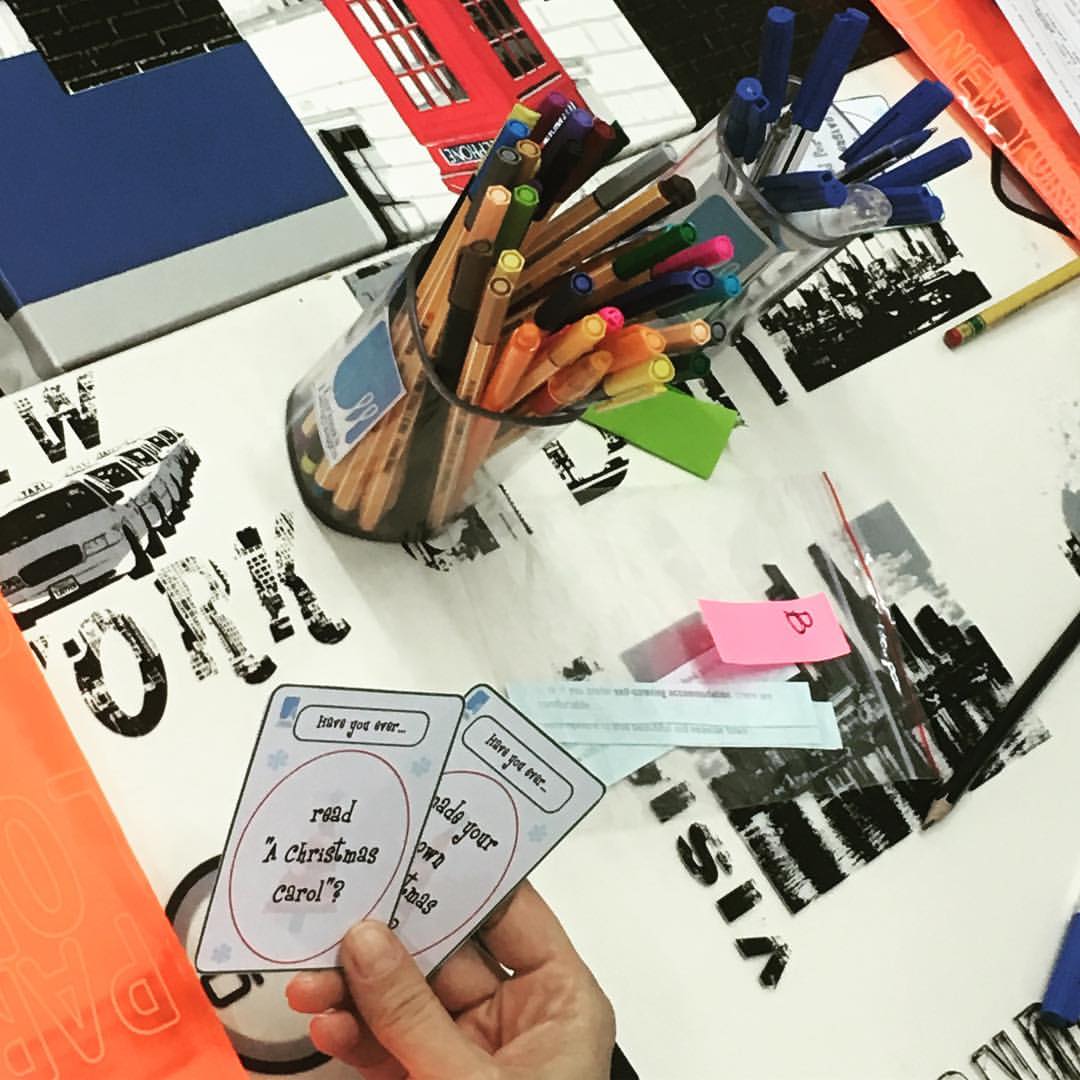
I made up a set of cards with "Have you ever...?" questions about Christmas.

TYPE OF GAME: CARD GAME
STUDENTS: YOUNG ADULTS/ADULTS A2-B1
LINGUISTIC SKILL: SPEAKING/LISTENING


HAVE YOU EVER... CHRISTMAS QUESTIONS
Just cut out the cards and put them face down on the desk.

Each student turns a card and read the question. Then decide who they want to ask the question to.

Or you can give each student 3 cards (I played with 5 students) and if the person they ask the question answers "Yes, I have" they can get rid of their card by putting it on the desk. But if the person they ask the question, answers "No, I haven't", they have to keep the card. The person who gives away all their cards first, wins! Of course students need to give explanation for their answers if they don't want to pick up their classmates' cards!


I hope you will have fun with your students!

domenica 1 maggio 2016

Cambridge FCE/FCE for Schools: Speaking Paper Tips

Some of my students are going to take the Cambridge FCE exam at the end of the month so I created for them this handy visual graphic with some tips to follow during the exam. I hope you and your students will find it useful!


You can also find a PDF printable version here.

lunedì 1 febbraio 2016

Teaching for exam? Touch your students' hearts

Lately this video https://vimeo.com/152985022 has gone viral on social networks. I was so moved when I watched it for the first time that I decided to introduce it in my exam-oriented classes. Today I'd like to share with you the lesson plan I used for my Cambridge FCE (B2 level) which focuses mainly on developing speaking skills.

STUDENTS: Teenagers (b2)
TIME: 1h30
AIM: Learning vocabulary about free time activities
Developing speaking skills for the exam.

1) WARM-UP ACTIVITY: Write on the board The Present and ask your students:
What’s the best present you have ever received?
(Spice-it-up version: Show a present box and tell your students you just got a present. Let them predict what's in the box)
2) VIDEO ACTIVITY: WATCH, PREDICT, ANSWER
Tell your students you are going to watch a video whose title is The Present

Start watching the video. Stop it at 00:50, ask them:
What do you think is in the box?

Start the video again up to 1:10, ask them:
Why doesn’t he like the dog?

Continue up to 1:25, ask them:
What does the dog want to do?
How does the boy react?

Continue up to 2:00, ask them:
Does the dog find it easy to play with the ball?
Does it give up or keep on trying to catch it?

Continue up to 2:40, ask them:
Choose three adjectives to describe the dog in the video.
CUTE - SAVAGE - DETERMINED - DANGEROUS - SWEET - WILD - FRIENDLY

Continue up to 3:00, ask them:
What does the boy decide to do?

2a) FOCUS ON LISTENING
Watch the video again and answer the following questions:

What language function do these statements express?
“Hey sweety, sorry I got home so late.”
__________________________________________________________

“Why don’t you stop playing and open the present I got for you?”
___________________________________________________________

“Mom, we’ll be outside.”
____________________________________________________________

3) Teach VOCABULARY

- Pair/group up students and give them the set of paper strips below. (Cut them out before giving them)
- Give them two labelled plastic bags 1) indoor activities 2) outdoor activities and ask them to put the strips into the right bag. The activities which can be done in either places will be left outside the bags.

- Have feedback and explain new vocabulary.

4) SPEAK UP!

Show these two pictures and ask students to do the task above.

or SPICE IT UP: Put students in pairs and make them sitting back to back. Give each one of them a picture and this grid. Students take turn to speak about their picture and tick off the words/phrases from the grid used by their partner. In this way they will practise the skills mentioned above.

4a) SPEAK UP AGAIN...

PASS THE TENNIS BALL GAME
- Get a tennis ball or a small ball.
- Make the students sit in a circle.
- Tell them you are going to ask them some questions.
- Pass the ball to the first student and ask one of the questions below. The student, then, will choose another student to pass the ball to. The second student will say if they agree or disagree with the previous student and why.
- Let 4-5 students express their opinion for each question.

People say “ A trouble shared is a trouble halved”. Do you agree?
Have you ever helped a friend in trouble? What did you do?
Are dogs really man’s best friends?
In what ways are dogs helpful to humans?
Do you think some owners care too much for their dogs and not enough for other people?

6) Homework is fun!
There are some people who become unfriendly because they have a physical disability or a problem. Prepare an encouragement quote using
www.quotescover.com (WEB)
InstaQuote (iOS) - Kwote (Android)


martedì 5 gennaio 2016

Teaching for exams? Have fun! Give a pep talk to yourself and your mates!

A new year has just started and most of my students have their resolutions made: take an English language exam.
Studying for an exam is always considered boring and tiring, but let's spice up this hard-working task with a pep talk!

What is a pep talk?
According to the Merriam-Webster dictionary a pep talk is "a short speech that is given to encourage someone to work harder, to feel more confident and enthusiastic, etc."

Everyone needs a pep talk not only students who are taking an exam so this lesson plan can be useful for any type of class!

Students: TEENAGERS/ADULTS
Level: UPPER-INTERMEDIATE/ADVANCED
Time: 1h30minutes
Linguistic skills: LISTENING & SPEAKING

1) I started my class by writing the phrase PEP TALK on the board and asked my learners if they knew what it meant.
They brainstormed some ideas I reported on the whiteboard without saying whether they were right or wrong.
2) After a few minutes I told them I was going to show them a video about a pep talk so they could check their predictions.

This is the link to the video: A Pep Talk from Kid President to You
3) After watching the video I collected some feedback and I gave my students some information about Kid President.

4) Listening activity: I cut out the following sentences and paired up students. They watched the video again and put in order the sections as they heard them. (To check if they were right we watched the video with subtitles).


5) It's time to take action! Students have to prepare their own pep talks. I gave my learners the following instructions and tips:

My students' talks lasted about 60-90 seconds. They filmed each other and it took them about 30 minutes to write their speech.

6) Finally, students listened to each other's pep talk.

I found this class both heart-warming and encouraging. I hope you get the chance to try something similar with your learners and if you do, please let me know!


sabato 23 maggio 2015

Teaching for exams? Have fun - A card game to revise

Luckily (or unluckily) it is that time of the year again! Exams!

This year to help my students to revise for their exams I made up a game with a deck of poker cards.

Age: Pre-teens, Teens, Adults
Level: from A2 to B2
What you need: a deck of poker cards/a whiteboard (smart board)

First of all, pre-teach some vocabulary about cards. Show your students the deck of cards and teach them the words suits, hearts, clubs, diamonds, spades, jack, queen, king.


Number of players:
2-20
In small classes (up to 8) players will play individually and you can write the questions on the board depending on their weaknesses and strengths.
I played this game with a class of 20 learners and I paired them up. In this case I used a smart board and the questions appeared on it (the cards where arranged in the same sequence as the questions)

Rules of the game:
Each suit corresponds to a language skill or sub-skill.
Revising for the Cambridge KET for Schools
Learners take turns to turn up a card. 
They will answer a question about a language skill or sub-skill according to the suit they get.
If they answer correctly they will get as many points as the number of suits on the card.
If their answer is wrong, other learners have the chance to get half points on the card if they answer correctly.


If learners pick up KING, they will lose 1 point.
If learners pick up QUEEN, they will double the points of the next question.
If learners pick up JACK, they will miss a turn.

Sample questions for the B1 level


My learners had a whale of a time because they had the chance to revise the topics of the exam without getting bored.
If you try this activity out, please let me know!

domenica 1 febbraio 2015

The power of free mobile apps - No 2 ThingLink

Here I am with the second post of the series "The power of free mobile apps".

Today I'd like to share with you some activities your students can do by using ThingLink (available on Web, Apple Store and Google Play).


What is ThingLink?

 Choose or take a picture with your phone’s camera and add interactive tags on your image such as YouTube videos, videos from your phone’s camera, twitter handles and text.
You can share your pictures with friends on Facebook, Twitter and Email.
If you sign up on the website as a teacher you can create a class and get email and password for your students to use.


Register your students


You can manage your groups
ACTIVITY 1
Grammar - Free practice - beginners/elementary
If you are teaching present continuous students can practise the TL by describing the actions of the people in a picture. 
What I did: My adults students chose a painting they liked and they described it.
See an example here The Luncheon of the Boating Party

ACTIVITY 2 
Literature -  Biography of a writer (any level)
[Remember you can add videos and links ;-) ]

ACTIVITY 3
CAMBRIDGE PET/PET for SCHOOLS - Speaking part 3
During this part the examiner gives you a colour photograph and you have to talk about it for about a minute.
Learners are often reluctant to speak in class especially shy students in large classes. By using ThingLink the learners can record their voice while describing the picture at home. 
What I have been doing: At the end of each class I ask my students to take a picture about the topic we have learnt in that session (e.g. sport, entertainment, the natural world, etc.) and describe it. In this way not only will they pratise their speaking skills for the exam but they will also revise the TL. 
[Remember that your video recording can be up to 30 seconds long so you must split your description in two parts]

If you have more ideas and activities to share I would love to post them here!


giovedì 13 marzo 2014

Useful tips for the Cambridge PET and FIRST Speaking papers

It doesn't matter whether you are teenager or an adult, speaking exams scare you, don't they? I came up with these two graphics to help my students and you face this overwhelming fear.
Dos & Don'ts and useful tips about the functional language to use in the different parts of the paper will support you to get trough the speaking exam.


 You can download the pictures and print them out!

giovedì 6 marzo 2014

If I Were A...Mayor: A Lesson Plan

When I plan my lessons for my groups of teens I always take into account:
1) Teenagers are creative and highly motivated.
2) The use of technology combined with real life is crucial in the classroom.
3) Teaching a language aims at communicating properly.
4) All the four linguistic skills must be introduced.

Considering these four points above I've created a series of lessons I call
I'd like to share with you the lesson plan If I were a mayor.
NOTE
Politics is not my cup of tea. This is not a lesson about politics. My aim is giving my students a chance to use the target language in a communicative way and in a real context. 

Students: TEENAGERS
Level: B1-B2
Time: 110 minutes (Ideal lesson plan for a 2 hour lesson)

Warm-up (5 minutes): 
WHAT TO DO
Tell your students they are going to guess a profession. Give them key words.
City/Town 
Hall
Laws
You can write them on the board so the whole class will guess and have fun together or set a challenge by giving the key words written on a paper and 1 minute to think about the possible profession. At the end of the minute the students will tell you which is their word.

IF SOMETHING GOES WRONG
If they couldn't guess it you can play the Hangman. 

Lead-into Listening (5 minutes):
WHAT TO DO
Ask the students:
How can you become a mayor?
Possible answers:
You need to be a politician./You need to win the elections./People must vote for you./You must run a campaign.

IF SOMETHING GOES WRONG 
Some students are reluctant to speak so try to elicit the answers.


Listening (20 minutes):
WHAT TO DO
Tell them they are going to watch a video of the mayor of London  when he was running his campaign. http://www.youtube.com/watch?v=M0heNP_EHmk
Let them watch the video twice and hand in the following questions. Let them check their answers in pairs and then get feedback.

IF SOMETHING GOES WRONG
This video is aimed at the citizens of London and not English language learners. Monitor students while they are watching the video and check they have most of the answers done. If not let them watch the video once again.

Reading (15 minutes):
WHAT TO DO
Students will now read a text I slightly modified from WRITING YOUR OWN CAMPAIGN SPEECH and they will answer some questions about it.
Give them 10-15 minutes to read and answer the questions.
You will find the handout here.

Lead-into Writing (5 minutes):
It's time to run for mayor. Let students brainstorm ideas about their own town, what they like and what they would like to change. Board their opinions so they can use them during the writing activity.

Writing (30 minutes):
WHAT TO DO
Now students write their own speech. Monitor and try to give them extra tips. You will find the handout in the link above.

IF SOMETHING GOES WRONG
By reading WRITING YOUR OWN CAMPAIGN SPEECH students will be able to write their own speech but focus on weaker ones. Let them use their dictionaries.

Speaking (10 + 20 minutes):
Students will rehearse their speech in pairs for 10 minutes.
Depending on how large your class is you can choose to work with the whole group or divide students in small groups. Students will give their speech in turn. Then everyone will vote for one to be the mayor (of course they cannot vote for themselves) and at the end of the lesson there will be a "new mayor" for your town.

IF SOMETHING GOES WRONG 
For some students this activity will be a chance to show off, don't be strict with them. Other students who are shy will feel ashamed to speak in front of the class/audience, give them more time to talk.


FOCUS ON GRAMMAR 
These activity will allow your students to review the 1st type conditional and the comparatives.

Try this lesson plan and let me know your feedback. I hope you will enjoy this lesson as much as my students and I did. 

Bye for now,
Larissa


giovedì 16 gennaio 2014

Social networks help teenagers improve their speaking skills

Italian parents always complain about the time their teenage children waste in front of a computer screen or on their smartphones. They say their children do not talk anymore, they just text.
Instead of blaming my teenage students I prefer using their "bad habit" to make them improve their English, especially their speaking skills.
A few months ago I published a post about how to use the Internet and Facebook to engage teenage students, today I'd like to share with you a lesson plan which might useful if your students are fond of social networking apps.

Students: Teenagers
Level: A2

Lesson plan
1) Warm-up: Write the following questions on the board
- Do you have a smartphone, PC, I-pod, I-pad?
- What social networks do you know?
- What do you use social networks or apps for?
Students ask and answer the questions in pairs.
TIP: Monitor students to check they are on the task and at the end of the activity ask some students randomly what their partner have told them. (It's a chance to practice the"s" of the third person singular)
ALTERNATIVE ACTIVITY: If you have a small ball like this
Students throw the ball and choose a question to ask to each other.

2) Show students this logotype
and ask them if they know which social network it stands for.
If they know it you can go to step 3 if they don't you can play the hangman like this
3) Prediction: Before showing students this infographic about Anomo (I took it from Metro.uk), 
write down these numbers on the board (I chose them to practice their pronunciation). In groups of 3 students predict in which way they refer to Anomo.
10,000
3m
90%
9 out of 10
540
Then hand out the infographic and ask them to check whether their predictions were correct or not.

4) Now focus students' attention on the expressions:
- ICE-BREAKER GAME
- GET-TO-KNOW-YOU-GAME
from the infographic, elicit their meaning and then show them this picture


5) Students write 5 "get-to-know"questions on 5 different pieces of paper.
Then they fold and put them in a plastic bag. Now shake the bag and ask a student to pick up a paper. S/he will answer a question and decide who will be the next one to reply.

At the end of the lesson students  will have:
- practiced the question forms,
- improved their speaking skill,
- enhanced their rapport with each other.

If you try this lesson plan, please let me know your feedback.