
martedì 4 marzo 2014

domenica 2 marzo 2014
martedì 18 febbraio 2014
Vocabulary & Grammar Auction: A Revision Game
Are you looking for a checking activity before a diagnostic or progress test about grammar and/or vocabulary? If your answer is yes you have just found the right post for you!
- What's an auction?
It's a public sale of goods or property, where people make higher and higher bids (= offers of money) for each thing, until the thing is sold to the person who will pay most.
- What's a Vocabulary&Grammar Auction?
 It's a fun game which will let teachers understand which topics students have assimilated well and which aspects students need to repeat. This game is perfect for pre-teens and teens but it is also suitable for adults (as a teacher who borrowed the idea told me). It usually lasts 1 hour.
1) Preparation
a.Worksheet with about 20 questions about the topics learnt.
b. British pound banknotes [I printed them from Google Images] (£6000 each pair or group)
- What's an auction?
It's a public sale of goods or property, where people make higher and higher bids (= offers of money) for each thing, until the thing is sold to the person who will pay most.
- What's a Vocabulary&Grammar Auction?
It's a fun game which will let teachers understand which topics students have assimilated well and which aspects students need to repeat. This game is perfect for pre-teens and teens but it is also suitable for adults (as a teacher who borrowed the idea told me). It usually lasts 1 hour.1) Preparation
a.Worksheet with about 20 questions about the topics learnt.
b. British pound banknotes [I printed them from Google Images] (£6000 each pair or group)
2) Procedure
a. Put students in pairs or in small groups (3-4)
b. Give them the same amount of banknotes and tell them they can bid up to £300 for each question.
c. Give students the worksheet and tell them they are going to answer 20 questions about the topics learnt. Time: 20 minutes.
d. Read the first question and students start bidding. When the bidding starts to fizzle out say, "Going once, going twice, sold!".
e. Get the money the pairs or groups bid.
f. One member of the highest bidder pair or group comes to board. If their answer is correct they will win the money the bid otherwise another pair or group have the chance to answer and get the banknotes.
g. Go through the 20 questions. The team with the highest number of banknotes will win the game.
3) Advantages
I think this game has two main advantages for students:
1. Peer teaching/correction - during the first 20 minutes students can share their opinions and doubts.
2. A remedy for shyness - if students are unable to answer or are insecure about a question they will just bid less or won't bid at all. In this way they won't get embarrassed in front of the others if they do not know how to answer a question.
If you play this game with your students, please let me know your impressions!

lunedì 3 febbraio 2014
The Power Of Language Exchanges
Learning English in a non-English speaking country gives students fewer chances to practice in real life what they learn in the classroom. However, I am sure that even in the smallest town of the world there are a few native English speakers. Find them! Why? Read the post and you will understand!
 A Language Exchange is considered a method of language learning based on mutual language practicing by learning partners who are speakers of different languages (ideally each learner is a native speaker in the language the proponent wants to learn). It is also called Tandem Language learning because there are usually two partners. They can meet in person, exchange e-mails, talk on the phone or today use social networks. It usually consists of an informal conversation which lasts about an hour, half the time is dedicated to one person and their language, the other half to the other person. In most cases the condition to take part to a self-directed tandem is to have a lower intermediate level.
A Language Exchange is considered a method of language learning based on mutual language practicing by learning partners who are speakers of different languages (ideally each learner is a native speaker in the language the proponent wants to learn). It is also called Tandem Language learning because there are usually two partners. They can meet in person, exchange e-mails, talk on the phone or today use social networks. It usually consists of an informal conversation which lasts about an hour, half the time is dedicated to one person and their language, the other half to the other person. In most cases the condition to take part to a self-directed tandem is to have a lower intermediate level.
When I set up my language studio besides teaching English, I gave Italian classes to the staff of the American ship and their families who settled down in my hometown. Once one of my Italian students ran into one of my American students during a break. They did not know how to communicate, whether in Italian or English. At that very moment I got the brilliant idea of holding a meeting in which my American and Italian students could practice their linguistic skills. I have been holding language exchanges since then. In order to allow all the students to take part to the event despite their levels I always plan carefully the activities.
CONVERSATION AND BOARD GAMES
Our language exchanges can be divided in two different kinds: CONVERSATION GAMES and BOARD GAMES. I'd like to share with you one example for each type.
Conversation Game: Speed dating
This is the first activity I did during a language exchange so as you can imagine it can be considered an ice-breaker. I got the idea from the speed dating taking place in bars to find a soulmate. Students were matched in pairs (if the number of people speaking the two different languages is even it is much better). They were given the worksheet in the picture below which helped them to start the conversation. They started speaking in Italian but after five minutes I rang a bell and they had to talk in English. Every five minutes I rang the bell and they swop the languages.
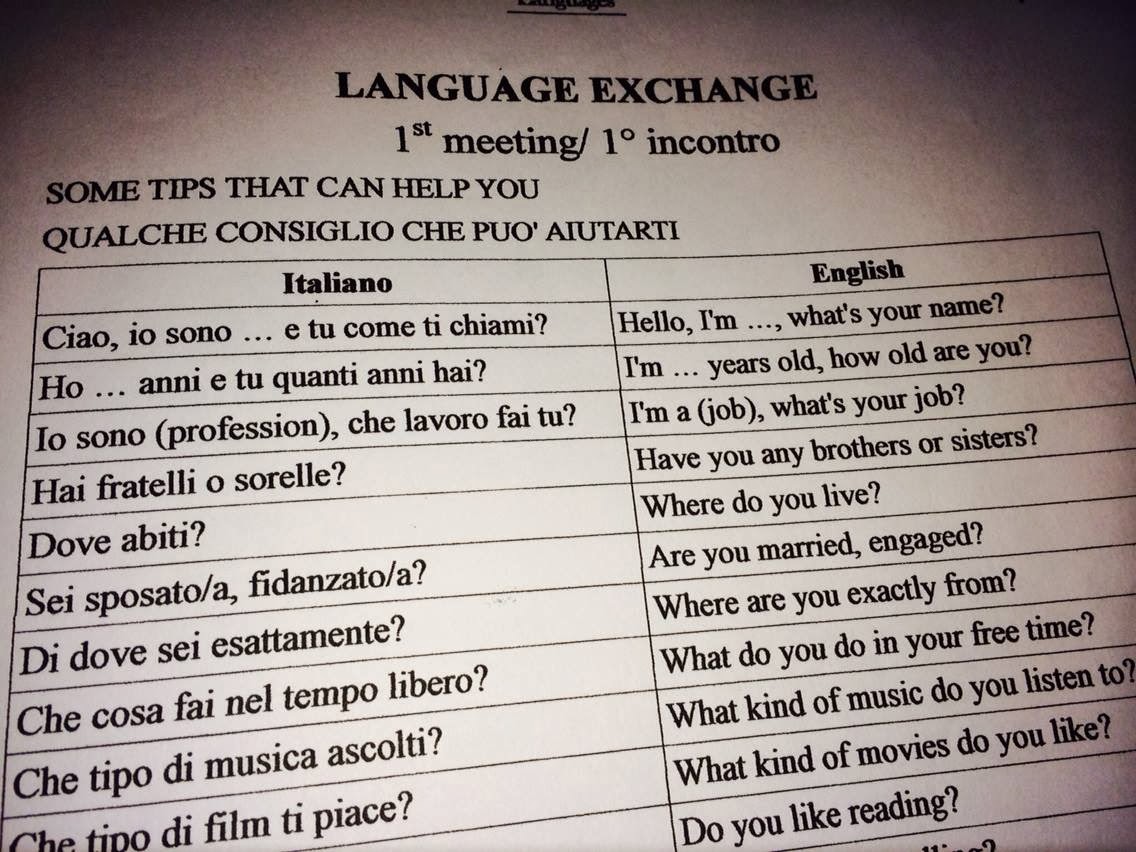
I recreated the relaxed atmosphere of the bar by offering them soft drinks, tea and coffee. They had so much fun as you can see in this picture.

Board Game: Visual Game


5 REASONS WHY I THINK LANGUAGE EXCHANGES ARE GREAT
In my opinion, learners get a lot of benefit from the language exchange. In this diagram you will find five reasons why language exchanges are great.
 To sum up, language exchanges cannot replace the teacher's lessons but they are a chance to practice what students learnt in the classroom and they let learners get closer to the culture of the language they are studying.
"The language exchange is a better way to learn and compare yourself with other people. You can listen to different pronunciations and accents", Silvia (upper-intermediate student)
giovedì 30 gennaio 2014
Karen Saxby's seminar about Cambridge English Young Learners
 Yesterday I attended a fantastic seminar by Karen Saxby. She was a teacher and she has been producing materials for young learners. Karen is the author of the books Fun for series for Starters, Movers and Flyers, the Story Fun series and KET for Schools Trainer.
I don't usually have the chance to attend seminars in my hometown or nearby so yesterday I was extremely excited to have this opportunity and Karen didn't let me down.
The seminar focused on Young Learners and it deals mainly about the following topics:
- intrinsic and extrinsic motivation
- creativity and critical thinking
- learners' success and self-confidence
Karen's presentation was bright, amusing and effective. She was able to involve all the audience. She expressed her ideas by using Realia and giving us effective practical examples. I absolutely agreed with her when she said that without caring and creativity instructions and directions are worthless to learners.

Even though the seminar focused on children and how making them feel important as individuals, I think creativity, motivation and fun are the keys for a successful learning process at any age.
In Karen's words, "you choose, you have the power". Only if we make our students feel indipendent and wonderfully different they will do their best.
Finally, two messages have stuck in my mind:
1) Our students will be much more motivated if we care about their well-being.
2) If your students are afraid of making mistakes, they will not feel confident about speaking or writing in English. Tell them that British children make mistakes too! They say things like, I wented to school. Those mens on television are funny. Making mistakes and learning how to correct them is part of the natural process of language learning. So tell your students not to be afraid to try using new words or new structures. They'll get them right if they practice... ! AND HAVE FUN in your classrooms.
Thank you, Karen.
domenica 26 gennaio 2014
Love English Awards 2013: if you like my blog, vote for it!
To my extreme surprise, I got nominated for the Macmillan Love English Awards 2013. If you like my blog, you can vote for it through this link. Thank you for following me!
http://www.macmillandictionary.com/love-english-awards/voting-blog-2013.html

http://www.macmillandictionary.com/love-english-awards/voting-blog-2013.html
giovedì 23 gennaio 2014
My first post for the Teaching English British Council blog
This is my first post for the Teaching English British Council blog. I am so grateful for having this chance. It means a lot to me. I will learn a lot from the other illustrious associates and I will share my experience with other teachers from all over the world.
This post is about teenagers and five tips to teach them successfully. I do hope you enjoy it! If you use any of the strategies mentioned, please let me know your feedback!
https://www.teachingenglish.org.uk/blogs/larissa84/top-5-tips-teaching-teenagers-larissa-albano
This post is about teenagers and five tips to teach them successfully. I do hope you enjoy it! If you use any of the strategies mentioned, please let me know your feedback!
https://www.teachingenglish.org.uk/blogs/larissa84/top-5-tips-teaching-teenagers-larissa-albano
Iscriviti a:
Post (Atom)